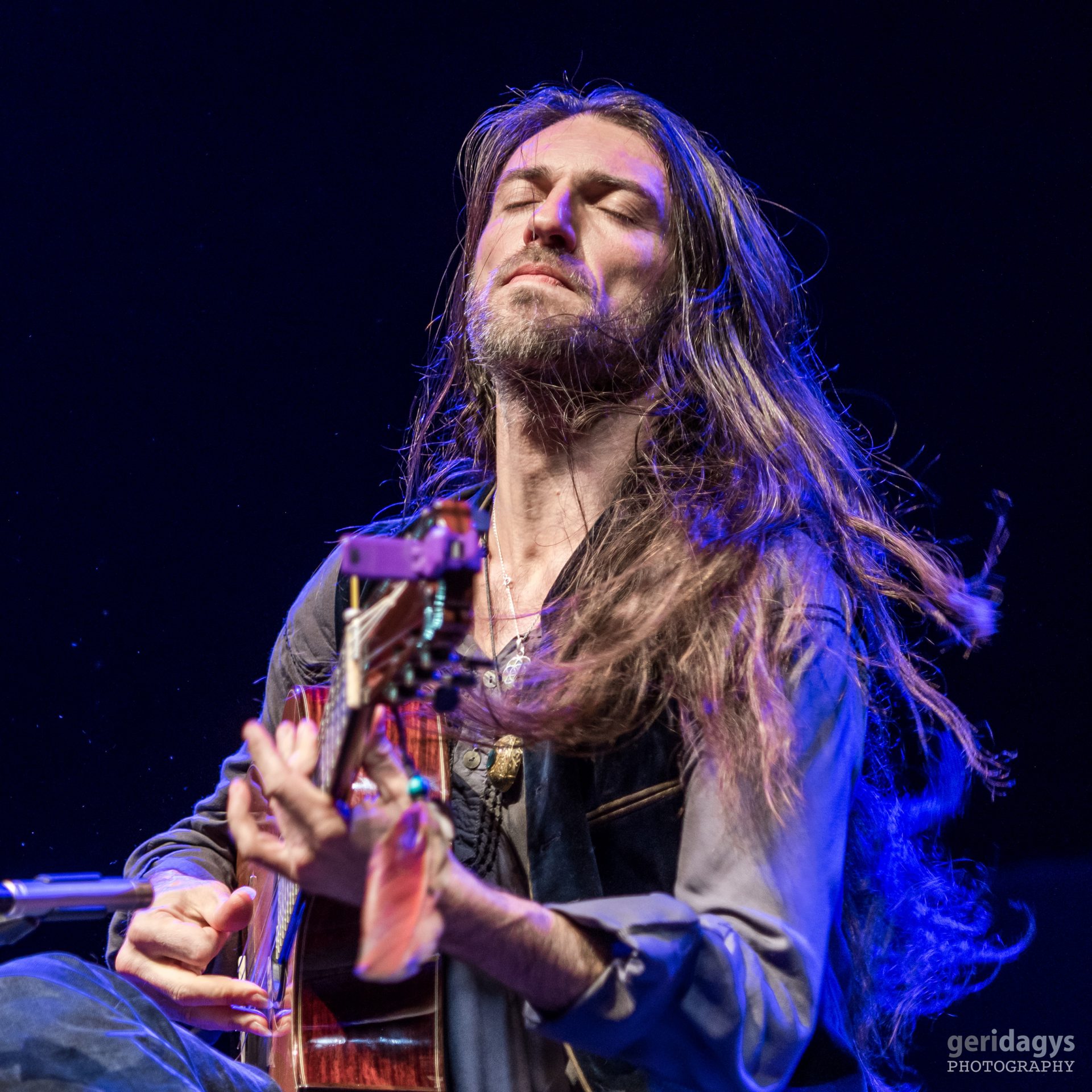

Estas Tonne describes himself as a "modern-day troubadour," and the phrase fits. He is a guitarist who has spent much of his adult life moving between streets, festivals, yoga gatherings and concert rooms, playing music that is largely improvised and shaped by the moment in which it is heard. Born Stanislav Tonne in 1975 in the Ukrainian SSR, he has become one of the more recognizable figures in contemporary meditative guitar, a musician whose work sits somewhere between concert performance, contemplative practice and what he and others call sound healing.
His audience found him less through conventional channels than through video. His best-known piece, "The Song of the Golden Dragon," has drawn more than half a billion views, a figure that places a deeply personal, improvisational style in front of an enormous global audience. Yet the story of how he arrived there is quieter and more circuitous than viral numbers suggest.
Tonne took up the guitar at the age of eight and began studying classical music at a local music school. It was a conventional start for a young musician in the Soviet system. One detail complicates the picture: he has spoken of a hearing defect in one ear that prevents him from perceiving musical notes correctly, and that this kept him from attending a conservatory. It is a striking fact for someone whose reputation rests on sound, and it may help explain why his approach is so rooted in feeling and listening rather than formal training alone.
In 1990 his family moved to Israel. He stopped playing guitar, and for eleven years the instrument went quiet in his life. Few details of that period are documented, but the length of the pause matters. When he returned to music, it was not as a prodigy resuming a trajectory but as an adult coming back to something he had set down.
That return came in September 2001, when Tonne moved to New York City and began playing again. He formed a duo with Michael Shulman, a violinist and street musician. Street performance, with its lack of ceremony and its immediate feedback from passersby, appears to have been formative. There is no stage, no frame, and no guarantee anyone will stop; music must hold attention by being alive.
From that partnership he began traveling as a solo musician. Over the years he has performed around the world in a range of settings, including street festivals, yoga festivals and art festivals. The troubadour description is not decorative. It reflects a working life built on movement and on playing for whoever is present.
Tonne describes his style as a fusion of gypsy, Armenian folk and flamenco fingerpicking. Listeners often hear in it a restless, flowing quality, with intricate right-hand work and melodic lines that seem to unfold rather than resolve.
His own language about music is less technical than spiritual. His official site speaks of authenticity and self-renewal, and of exploring the individuality of sound and how a sounding source can open a creative space for the listener, for wellbeing and for a shift. On his YouTube channel he puts it more plainly: music "is not about notes, chords or songs but the breath of life that goes through everything, each and every one."
The music is largely spontaneous. His album Old Style was recorded in a single take in the studio, with no loops or samples, a deliberate choice that puts the emphasis on presence and risk over polish.
Tonne's discography includes Internal Flight (2013), Mother of Souls (2016) and Anthology, Vol. III (Acoustic) (2023). He has also released live recordings, among them Sound Ceremony, recorded in Zurich in spring 2024. Beyond his solo work, he has released music with Sanya Kroitor and has collaborated with other musicians, including Michael Shrieve.
Much of what has made him known, however, exists as performance footage. The video format suits his work, which depends on seeing hands, faces and settings as much as hearing notes.
Out of this body of work grew the Internal Flight Experience, a three-hour session that began as an inner sound journey. After more than a decade of experimenting, it developed into a fuller practice combining sound, spontaneous movement, vocalised release, breath awareness and silence. Its stated aim is to help participants let go of physical and mental tension and listen inward.
This marks a meaningful shift in Tonne's role. In the Experience, the guitarist is less a performer for an audience than a guide for a collective process, and the music becomes one element among several. It is also why he is often associated with yoga and meditation communities, and why a teacher's role sits alongside that of a musician.
Recent years show a musician continuing to document and refine this territory. Anthology, Vol. III (Acoustic) arrived in 2023, and Sound Ceremony, captured live in Zurich in spring 2024, reflects the ceremonial, participatory direction of his current work. The emphasis appears to be on live, shared experience: gatherings in which listening itself is the activity.
Tonne's reach is large but unusual. His Spotify following, a little over six thousand, is modest beside his video audience, which suggests that his listeners tend to meet him visually and in person, in yoga rooms, festivals and online, rather than through streaming playlists. That pattern says something about the kind of music he makes: it asks to be witnessed.
His cultural significance lies in how he bridges worlds. He carries the discipline of classical training and the folk idioms of several traditions into spaces where music is used for rest, release and reflection. For many people who may never attend a guitar recital, he offers a way into sustained, attentive listening.
There are reasonable questions to ask about any artist working in the wellness-adjacent world, and Tonne's claims about music's transformative power are belief as much as fact. But the craft is not in doubt, and neither is the consistency of his vision. A boy who began guitar at eight, fell silent for eleven years and returned on the streets of New York has built a life around the idea that sound, offered honestly and in the moment, can change how a person feels. That conviction, more than any view count, is the core of his work.