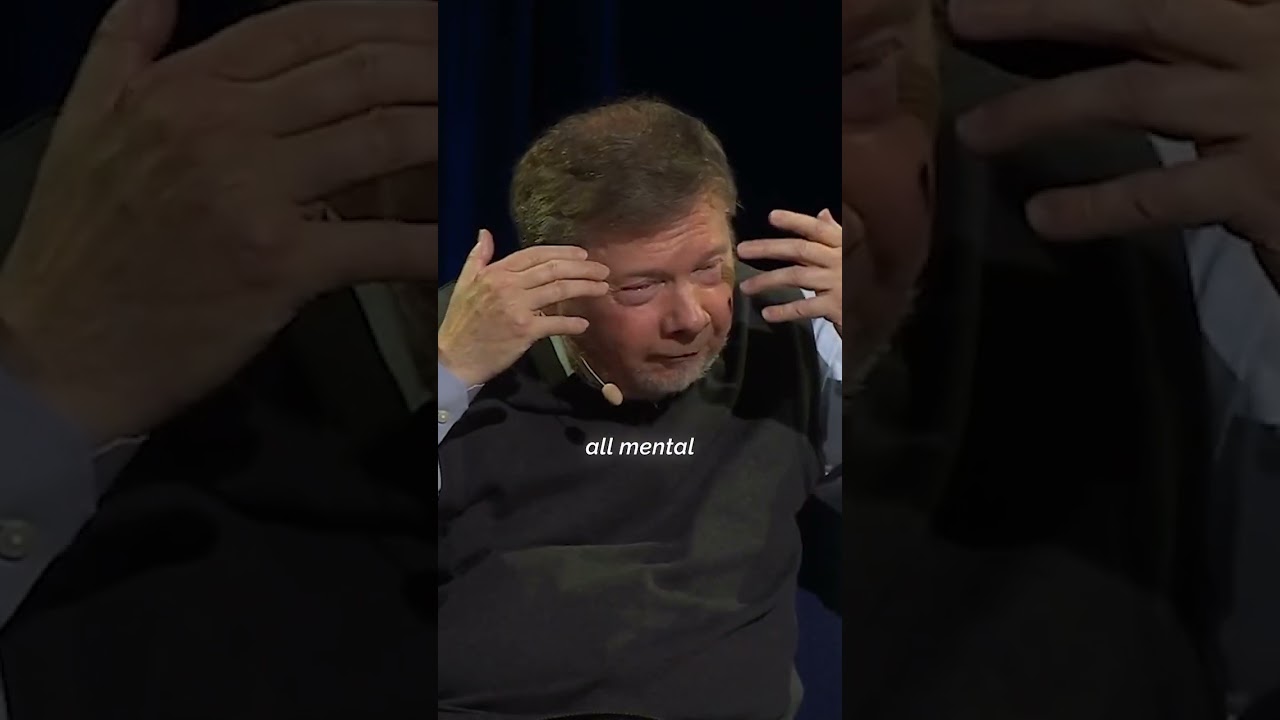
Eckhart Tolle examines the nature of death as a transition of consciousness rather than an ending, arguing that the intelligence animating the human body cannot be reduced to physical processes alone. He explores how presence, awareness, and the sacred dimension of existence continue beyond biological death, inviting a fundamental shift in how we understand life, form, and the nature of consciousness itself.
Why We Cannot Reduce Consciousness to the Physical Body
One of the central insights Tolle addresses is the inadequacy of purely materialist explanations of consciousness. The body operates through complex biological and chemical processes, yet these processes alone do not account for the subjective experience of being alive—the felt sense of presence, awareness, and the "I am" that persists throughout our lives. Tolle suggests that the intelligence animating the body, the aliveness that animates every cell and system, points to something that cannot be contained within or reduced to matter.
This is not mysticism for its own sake, but an observation of lived experience. We know consciousness exists; we experience it directly. Yet neuroscience has not successfully explained how physical matter generates subjective awareness. Tolle's perspective reframes this not as a scientific puzzle to be solved, but as evidence that consciousness is fundamental—not derivative from matter, but prior to it.
What Is the Intelligence That Animates Life?
Tolle points to an intelligence at work throughout all living systems. Consider a seed becoming a tree: nowhere in the seed's DNA do we find instructions for the shape of the tree, the quality of its bark, or how it will respond to wind and rain. Yet life unfolds with extraordinary precision and creativity. Similarly, in the human body, trillions of cells communicate and coordinate without conscious direction from the thinking mind. Your heartbeat, digestion, immune response, and wound healing occur beyond the scope of thought.
This intelligence is not separate from you—it is the deeper dimension of existence that animates all form. Tolle suggests that what we call consciousness or presence is fundamentally connected to this intelligence. When the physical form dies, the body returns to matter, but the intelligence itself—the animating principle—does not cease to exist. It returns to its source, much as a wave dissolves back into the ocean.
Death as a Transition, Not an Ending
From Tolle's perspective, death is not a termination of existence but a transformation of form. The body is like a garment worn by consciousness; when it wears out, consciousness does not perish—it simply no longer animates that particular form. This understanding shifts death from a final and terrifying boundary to a natural passage within a larger continuum of existence.
This does not necessarily presume reincarnation or survival of a personal self. Rather, Tolle suggests that death represents a release from identification with form—the thoughts, memories, and ego that comprised the sense of "I am this body" dissolve, but awareness itself, the pure presence underlying experience, returns to what it always was: the formless ground of being.
The Sacred Dimension Beyond Life and Death
Tolle speaks of a sacred dimension of existence that transcends the dualities of life and death, form and formlessness. This dimension is accessible not only after death, but here and now through deep presence. When you quiet the mind and rest in pure awareness—in what Tolle calls the Now—you touch something timeless and infinite. This is the same dimension that consciousness returns to at death.
The sacred is not confined to moments of crisis or transcendence. It is the underlying reality of existence itself. Everything that appears in form—the universe, bodies, thoughts, emotions—emerges from and exists within this sacred, timeless dimension. Death simply makes visible what is always true: that form is temporary, but the intelligence and presence within which all form arises is eternal.
How Presence Relates to the Nature of Death
One of Tolle's key teachings is that true presence—the full inhabitation of the present moment—is already an opening to the dimension beyond time and death. The Now is not a moving point on a timeline; it is a doorway to the eternal. When you are fully present, thought quiets, the sense of a separate self diminishes, and you touch something vastly larger than the individual ego.
This is why contemplative practice matters. Through meditation, mindfulness, and the practice of presence, you become familiar with the dimension that death opens into. You no longer experience awareness as confined to a body or mind; you begin to recognize awareness as the fundamental fabric of existence. In this sense, the "death" of the ego-self—which occurs repeatedly in deep presence—is a rehearsal for and preparation for the ultimate release that physical death brings.
The Body Returns to Matter; Consciousness Returns to Source
At death, the body's biological processes cease, and the physical form begins to decompose. This is not denial but simple fact. The atoms that composed your body return to the earth and the elements. But the intelligence that coordinated those atoms, the consciousness that was aware of having a body—this does not decompose. It cannot, because it was never fundamentally dependent on the physical form.
Tolle invites us to notice the paradox: we begin life with no memory of birth, and we end it with no certainty of what comes after death. Yet the intelligence of existence brought us into form and animates us throughout life. Why should it suddenly cease to exist? More likely, we return to the state we were in before birth—not oblivion, but a dimension beyond the limitations of space, time, and individual form.
Fear of Death and the Ego's Final Resistance
The fear of death arises largely from ego-identification—the sense that "I am this body, this mind, these thoughts, and when they end, I end." But the deeper you explore your own consciousness, the more you realize that the "I" you truly are is not these temporary forms. Your awareness was present before you could think. It is present in the gaps between thoughts. It is the unchanging witness of all that changes.
From this recognition, fear of death can transform. Not through denial or blind faith, but through direct insight into the nature of consciousness itself. The ego, which depends on temporal existence and the boundary of separation, will naturally resist and fear its own dissolution. But the consciousness that witnesses the ego is untouched by this fear. At death, this untouched consciousness simply ceases to identify with form.
Where to Go From Here
If Tolle's exploration of death resonates with you, the natural next step is to deepen your direct experience of the dimension he describes. This happens through the practice of presence. Begin with simple awareness exercises: notice your breath without trying to change it; feel your body as a field of aliveness; observe the space between thoughts. These practices are not preparation for some future spiritual goal—they are direct encounters with the eternal dimension that transcends life and death.
Consider also how this understanding shifts your relationship to life itself. If consciousness is not ultimately threatened by death, then the pressure to grasp, achieve, and control diminishes. You become freer to live, to love, to create, and to be present to the precious aliveness of this moment. The recognition of the sacred dimension beyond form can paradoxically deepen your gratitude for form, for the extraordinary gift of embodied existence. From this understanding, death becomes not an enemy to be feared, but a natural homecoming to the intelligence from which all life emerges.