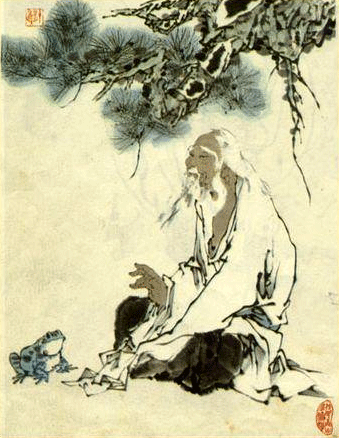
Finding Depth in the Subtle: The Wisdom of Chuang Tzu
Chuang Tzu's assertion, "To see the small is to have insight," invites us to reconsider our perceptions of the world around us. In a culture that often glorifies the grand and the monumental, this quote serves as a gentle reminder of the profound wisdom that can be found in the minutiae of life. It suggests that true insight does not come from grandiose visions or sweeping narratives but rather from a careful and contemplative observation of the small, often overlooked details that shape our experiences.
This perspective is particularly relevant in our fast-paced, distraction-laden lives, where the small moments are frequently eclipsed by the noise of ambition and urgency. By cultivating an awareness of the subtle nuances in our surroundings, we can deepen our understanding of ourselves and the world. Chuang Tzu's wisdom encourages us to slow down, to engage with the present moment, and to appreciate the intricate tapestry of existence woven from the threads of the ordinary.
The image / the metaphor
The imagery in Chuang Tzu's quote evokes a sense of intimacy with the world. The phrase "to see the small" conjures visions of a delicate flower, a fleeting moment of laughter, or the gentle rustle of leaves in the wind. These small elements, often dismissed as trivial, are imbued with significance when we take the time to observe them. The verb "see" implies not just a passive glance but an active engagement, a willingness to delve deeper into the layers of meaning that reside within the seemingly insignificant.
Metaphorically, "seeing the small" can be understood as a practice of mindfulness, an invitation to cultivate a discerning eye that recognizes the interconnectedness of all things. In Taoist thought, this perspective aligns with the concept of "wu wei," or effortless action, which encourages us to flow with the natural rhythms of life rather than resist them. By embracing the small, we learn to navigate the complexities of existence with grace and ease, finding insight in the very fabric of our daily lives.
In the speaker's tradition
Chuang Tzu's teachings are deeply rooted in the Taoist tradition, which emphasizes harmony with the Tao, or the fundamental nature of the universe. This philosophy encourages a profound appreciation for the present moment and the small details that often go unnoticed. Concepts such as "prajna," or wisdom, and "sunyata," or emptiness, resonate with the idea that true understanding arises from a deep awareness of the interconnectedness of all things. In this light, seeing the small becomes a pathway to greater insight and enlightenment.
In the "Zhuangzi," the text attributed to Chuang Tzu, we find numerous anecdotes that illustrate the value of humility and simplicity. One such story involves a humble farmer who, despite his modest circumstances, possesses a profound understanding of the natural world. His ability to appreciate the small details of his environment allows him to live in harmony with the Tao, demonstrating that insight often arises from a place of simplicity and attentiveness. This narrative serves as a reminder that wisdom is not confined to the learned or the powerful but is accessible to all who are willing to observe and reflect.
Living the teaching
Consider a modern scenario where this teaching can be applied: a busy professional navigating the demands of a hectic workday. In the rush to meet deadlines and achieve goals, it is easy to overlook the small moments that can provide clarity and insight. By intentionally pausing to appreciate the warmth of sunlight streaming through a window or the sound of laughter shared with a colleague, one can cultivate a sense of presence that enriches the work experience. This practice not only enhances personal well-being but also fosters deeper connections with others.
In the realm of relationships, the teaching of seeing the small can transform interactions. Imagine a couple facing a challenging moment in their relationship. Instead of focusing solely on the larger issues at hand, they might choose to acknowledge the small gestures of love and support that often go unnoticed—a gentle touch, a shared smile, or a moment of understanding. By recognizing and valuing these small expressions of care, they can foster a deeper sense of connection and insight into each other's needs, ultimately strengthening their bond.
A reflection
As we contemplate Chuang Tzu's wisdom, we are invited to reflect on our own perceptions of the world. What small details have we overlooked in our pursuit of larger goals or aspirations? In what ways can we cultivate a deeper awareness of the present moment, allowing ourselves to find insight in the ordinary? As you ponder these questions, consider how embracing the small might lead to a richer, more meaningful experience of life.




Join the BrightStar Community
Stay connected with daily inspiration, event announcements, and community wisdom