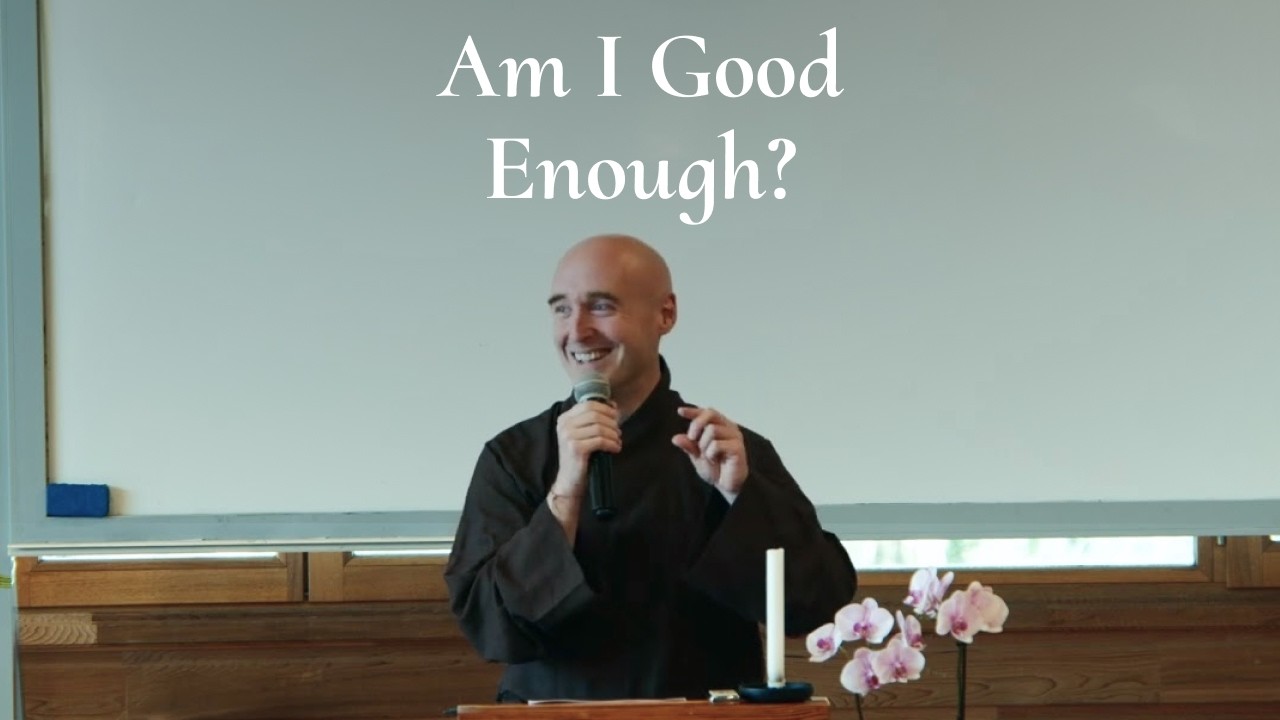
Transcript
[0:02] Good morning dear friends. Welcome to
[0:05] the first full day of our uh retreat uh
[0:10] the wonder of it all.
[0:12] Um
[0:14] it's quite a pleasure to be here as a
[0:17] community of uh scientists maybe some
[0:21] non-scientists as well. Can you hear
[0:30] Very interesting. If you can't hear
[0:32] outside, I think you'd have to come
[0:34] inside.
[0:38] Uh
[0:40] okay. Uh it's quite a pleasure to be
[0:44] here together as a community
[0:47] and um I think uh in our times right now
[0:53] um just to be able to experience things
[0:57] as a community as not as an individual
[1:00] but but as a community is becoming more
[1:04] and more maybe rare. Uh I I I would say
[1:10] so this morning just to be able to be
[1:13] together, to sit and then to listen to
[1:16] the sound of the bell together, to be
[1:19] able to breathe together,
[1:22] uh experience this dharma talk together.
[1:25] And if you want to maybe
[1:29] if you should get bored, you can get
[1:31] bored together.
[1:34] Or if you should laugh, you should, you
[1:37] know, you can we can laugh together. So
[1:40] this experience of togetherness we can
[1:42] feel it in our body and um so listening
[1:47] to three sounds of the bell we can close
[1:50] our eyes come back to our breathing and
[1:53] really experience uh breathing together
[1:56] as a community being here together as a
[1:59] community and how wonderful it is for
[2:02] our bodies just to have this opportunity
[2:05] to not have to do anything. You don't
[2:07] have to strive. You don't have to go
[2:09] anywhere. We're just sitting here
[2:11] listening to something.
[2:13] Uh please enjoy the three sounds of the
[2:16] bell.
[2:25] [Music]
[2:45] [Music]
[3:38] Oh,
[4:26] Good morning.
[4:28] Uh coming back to the body. Um I feel my
[4:33] hands are quite hot. It's really warm in
[4:38] uh my hands at the moment. I don't know
[4:41] if it's from nervousness or
[4:45] from the temperature.
[4:47] Um
[4:49] but um yesterday brother Fapu spoke
[4:53] about uh the importance of coming home.
[4:57] Coming home especially to the the body.
[5:00] We are so used to engaging so much with
[5:03] our intellect that um maybe coming here
[5:08] and uh being reminded quite often and
[5:13] frequently very frequently to come home
[5:16] to our bodies might be a bit challenging
[5:18] for some of us. For some of us, uh it
[5:22] may be because
[5:24] we're not used to, uh coming home to the
[5:28] body, being with the body,
[5:31] um feeling the body. And for others of
[5:35] us maybe
[5:38] coming back to the body um is difficult
[5:42] because
[5:44] um maybe we have memories that uh maybe
[5:49] coming back to the body can touch some
[5:51] memories some suffering. So it's very
[5:54] difficult for us to come back to our
[5:57] bodies. Maybe intellectually we don't
[6:00] think about it but somehow a part of us
[6:04] automatically kind of rejects coming
[6:06] home to the body. So being in a retreat
[6:11] setting like this and we're invited
[6:14] we're invited to come home to the body.
[6:18] Um some of us may have a very pleasant
[6:21] experience some of us may have a more
[6:23] challenging uh experience. Uh
[6:26] nonetheless
[6:28] uh coming home to the body uh we can
[6:32] learn so much about ourselves. Uh we can
[6:37] learn so much about our histories.
[6:40] Uh we can learn so much about what is
[6:43] going on for us in the present moment.
[6:46] Uh sometimes um I just need to come back
[6:51] to one breath, a few breaths maybe. Um,
[6:56] and I can see how I'm doing in the
[6:59] moment. I can see how much tension I
[7:02] have been holding.
[7:05] And uh, just coming back to the body in
[7:08] the present moment. I can see maybe how
[7:11] I've lived my life in the past hours, in
[7:15] the past days or in the past weeks. And
[7:19] uh, it has an impact in my body in the
[7:22] present moment.
[7:24] So just allowing myself to come home to
[7:28] be with the body to feel the body and to
[7:31] have a chance to take care of it. Uh we
[7:34] know that in our body tensions uh often
[7:37] accumulate
[7:40] and um I um some you know here we hear
[7:45] we listen to the sounds of the bell a
[7:47] lot and every time we hear the sound of
[7:49] the bell we're invited to stop what
[7:52] we're doing to come back to the body
[7:54] come back to the breathing to recognize
[7:57] what is going on in our body and in our
[8:00] mind and in the environment
[8:03] And um very often I always notice
[8:07] there's tensions in my shoulders.
[8:10] And maybe the activity bell was just
[8:13] invited 15 minutes ago and I just done
[8:17] that exercise 15 minutes ago. But being
[8:20] here in this room and listening to the
[8:22] bell again and I come home to my body
[8:25] again,
[8:27] I feel the tension has accumulated again
[8:30] just within 15 minutes. So I I recognize
[8:33] there's a baseline of tension in uh my
[8:37] body that I need to take care of and um
[8:42] and to take care of regularly. It's not
[8:44] like we do it once and it's it's over
[8:47] but it's constant uh coming home to our
[8:50] bodies and constant uh care.
[8:55] Um
[8:57] so this is something that we would love
[8:59] to invite you to do. uh throughout the
[9:02] retreat cultivating the capacity to come
[9:06] home to the body
[9:09] uh noticing what is going on in the body
[9:12] and how can we take care of it right in
[9:15] the present moment. There are some
[9:17] things we can take care of right away.
[9:20] Releasing tension is something we can do
[9:22] right away.
[9:24] um
[9:26] uh sending compassion to ourselves is
[9:30] something we can do right away if uh
[9:35] maybe for some of us um for myself I
[9:39] know growing up uh I wasn't very
[9:41] comfortable with my body
[9:44] and um uh very often wanting another
[9:49] body
[9:51] so coming home to the body sometimes is
[9:53] a bit challenging. There is a tendency
[9:56] to reject to reject the body and how it
[10:00] is in the present moment. So for me
[10:03] coming home to the body and just sending
[10:05] myself acceptance uh compassion
[10:09] and uh the commitment to take care
[10:13] uh um I will take care of you. I would
[10:18] take good care of you.
[10:20] uh I'm committed to taking good care of
[10:23] you.
[10:24] And sometimes we we we can commit to
[10:28] taking care of many things uh
[10:30] relationships, our job, our
[10:33] responsibilities,
[10:35] etc., etc. But
[10:38] commit making the commitment to take
[10:40] care of ourselves, to take care of our
[10:42] body, maybe is a lot more challenging.
[10:45] We might feel uh a bit of guilt or it
[10:49] could be that we're just not used to it.
[10:51] We're just not used to making the
[10:54] commitment to take care of ourselves.
[10:58] Uh so this week we invite you at many
[11:02] moments throughout the day. How can I
[11:04] come home to my body? What is going on?
[11:07] And how can I take care of it? Uh right
[11:11] in the present moment.
[11:20] So a lot of uh I think Zen training is
[11:24] about um
[11:27] applying applied insights, practicing to
[11:31] get the insights and then to apply the
[11:34] insights to live the insights. Um
[11:39] and uh I think science in your work and
[11:42] your research uh there's also the
[11:46] aspiration to get insight, aspiration to
[11:49] get understanding
[11:51] and uh
[11:54] um for both the yogis and uh scientists
[11:58] uh I think
[12:02] uh a very practical practical goal is uh
[12:06] how to How can we apply the knowledge
[12:09] that we accumulate that we uh acquire
[12:14] um so that we can take care uh and deal
[12:18] with our happiness and suffering?
[12:22] Um, how can our knowledge, how can our
[12:25] insights help us to one um
[12:30] recognize um the presence of uh the
[12:35] wonders to recognize the wonders the
[12:38] wonders that are inside of us, the
[12:40] wonders that are all around us and uh
[12:44] recognizing these wonders to generate
[12:46] joy and uh to feel nourished and to heal
[12:51] ourselves. elves.
[12:54] And then how can our knowledge, how can
[12:57] the insights that we have help us to
[13:01] recognize a painful feeling?
[13:04] Um to recognize a painful feeling, to be
[13:08] able to calm it, to be able to bring
[13:11] relief to it, and to be able to
[13:14] transform it. I think this is the
[13:16] subject for tomorrow's dharma talk.
[13:19] Transforming uh habits and uh
[13:23] transforming
[13:26] uh recognizing painful feelings and uh
[13:30] and transforming them a little bit about
[13:33] habit change.
[13:38] So we we put a lot of emphasis on
[13:41] applied applied uh knowledge because we
[13:44] don't just want to stay up here. Uh the
[13:48] knowledge we we have we currently
[13:50] possess um must be must be applied and
[13:54] first and foremost applied to ourselves
[13:58] uh to our own understanding of our body
[14:01] and our mind. And this is very important
[14:05] uh understanding what is going on in our
[14:07] body, understanding what is going on in
[14:10] our feelings, understanding what is
[14:12] going on in our mind in the present
[14:15] moment so that we
[14:19] um
[14:21] have an understanding of our own
[14:24] humanity.
[14:26] Uh I think science um
[14:29] uh can serve be of service to humanity.
[14:33] Uh but to be able to be of service to
[14:36] humanity, we have to be able to first
[14:37] and foremost understand our own uh
[14:41] humanity. And I think this is what we as
[14:44] a community of scientists and are are
[14:48] here to do this week. How can we
[14:50] understand together more of our humanity
[14:54] so that um we can kind of uh um
[15:05] do the kind of science that can be uh
[15:08] more of service to humanity.
[15:13] And um
[15:15] maybe this week coming back to the body
[15:18] may not be easy. Coming back to the
[15:21] feelings uh may not be easy or maybe new
[15:24] to many of you. Some of you I see you're
[15:27] seasoned practitioners.
[15:29] And uh coming back to the mind may also
[15:33] maybe not new to you. You may already
[15:35] think that you know how to come back to
[15:37] the mind. Uh we'll see.
[15:41] Uh we'll see. Um
[15:45] but what I mean by it might be
[15:48] challenging to come back to the body,
[15:50] the feelings or the mind is because we
[15:54] might have we might have been uh used to
[16:00] kind of numbing ourselves.
[16:02] Uh our work is challenging on many
[16:06] fronts. There's deadlines, there's
[16:09] competition. Uh there's things to do um
[16:17] uh many challenges to meet and uh in
[16:20] order to kind of uh handle these things
[16:24] these challenges
[16:26] um to be able to
[16:28] deal um uh
[16:33] uh with the difficulties. We may have a
[16:36] tendency to numb to numb ourselves just
[16:39] so we can get through it just so we can
[16:41] push through because uh one of our
[16:44] deepest habits is uh to have an outcome
[16:48] to
[16:50] uh we're very goal oriented. We're very
[16:53] future
[16:54] success. I guess success looks a certain
[16:57] way. Success looks a certain way and
[17:00] then we have that kind of striving. We
[17:03] need to be able to um get somewhere to
[17:07] accomplish something
[17:10] and uh in order to get somewhere and to
[17:12] accomplish something sometimes uh we end
[17:15] up having to numb ourselves otherwise we
[17:18] wouldn't be able to get there. Um and
[17:22] this is um something that maybe as a uh
[17:27] uh community we can we can look deeply
[17:31] into. We numb ourselves by forgetting
[17:34] about our bodies. We can be in front of
[17:37] the computer for many many hours and uh
[17:40] not really notice.
[17:42] Um to tell the truth, sometimes I fall
[17:45] into this category too.
[17:48] Uh which is
[17:51] um
[17:53] which is why I'm very lucky to um to
[17:55] have community around me to remind me
[17:58] that uh maybe this isn't always the best
[18:00] thing. Uh I have sisters to uh tell me
[18:04] to go for a walk.
[18:07] uh I have uh uh brothers and sisters to
[18:11] remind me to go eat. Uh I have the
[18:14] schedule of the community to say okay
[18:17] it's time not to be in front of the
[18:19] computer anymore. So in that regards uh
[18:23] I rely very much on the community to
[18:26] kind of uh give me a bit of balance.
[18:32] Uh
[18:33] yeah, and sometimes um we're so used to
[18:37] numbing ourselves, we don't even notice
[18:39] it. Uh
[18:43] what I found recently was um I hadn't
[18:47] realized I was uh a bit becoming
[18:50] uncomfortable talking about my feelings
[18:54] because I find recently I've had uh uh
[18:58] let's say you can say a full plate
[19:01] And uh uh if someone asks me, "Oh,
[19:04] sister, how are you?" Not a normal how
[19:07] are you? A very serious how are you?
[19:09] Like they really want to know how I'm
[19:12] doing, what's going on, what are my
[19:14] challenges, what are my difficulties.
[19:17] And then I find
[19:19] uh well, you know, I'm okay, I guess.
[19:23] you know, last week we just finished uh
[19:25] whatever living gems and uh uh and then
[19:30] I I go into talking about the work. I
[19:32] can't talk about my feelings. I don't
[19:35] know if you've had this experience.
[19:37] Someone comes up to you and asks you,
[19:39] "Ah, how are you doing?" And you're
[19:41] like, "Ah, it's great. Yesterday I just
[19:44] turned in a paper for publications." And
[19:47] then you end up talking about the
[19:48] publication
[19:50] and uh we can't talk about our feelings
[19:54] maybe. And I find I found ah I noticed
[19:58] this is this is my way of numbing.
[20:02] This is my way of numbing. I don't even
[20:04] want to talk about my feelings.
[20:06] Um
[20:08] uh because talking about my feelings
[20:10] might be a bit messy. I might end up uh
[20:14] crying. I might end up uh uh showing
[20:17] more vulnerability than um than I really
[20:21] want to.
[20:23] Uh so I divert to you know the weather's
[20:27] too uh too obvious so I don't do that
[20:29] anymore. But
[20:34] I get into more sophisticated things and
[20:37] even even sometimes talking about the
[20:40] dharma. You know, somebody asked me how
[20:43] you know what my re latest insight is
[20:46] and then and then I end up talking about
[20:49] my latest insight which has not almost
[20:52] nothing to do with my feelings. So in a
[20:55] moment uh food for thought
[21:00] so maybe we can listen to one sound of
[21:02] the bell
[21:04] come back to our breathing our body
[21:08] really take a moment to notice what is
[21:12] going on in terms of the realm of
[21:14] feelings for us in this moment. Okay.
[21:24] [Music]
[22:18] Um
[22:20] so
[22:23] in a way many of the practices that uh
[22:26] we are introducing uh to you this week
[22:30] are practices to kind of help us to take
[22:33] care of not just our body but also our
[22:37] mind. Uh because we know that uh and
[22:41] when I say body and mind, I'm not saying
[22:43] they're two separate things.
[22:46] We'll get into that. Um
[22:49] um well taking care of body and mind
[22:53] because uh we find that our health and
[22:56] also
[22:57] uh our mind the health of our body and
[23:02] mind has a lot to do with the health of
[23:05] the kind of science the health of
[23:07] science the science that we do. So
[23:14] for us uh uh for for the Buddhists and I
[23:19] guess
[23:20] uh and many others uh the mind is a very
[23:26] important instrument maybe the most the
[23:29] most important instrument because it is
[23:33] behind all of the work and research and
[23:37] actions that we do. So it's very
[23:40] important to be able to take care of our
[23:43] mind of our consciousness.
[23:46] Um so this morning um
[23:50] I would like to share a little bit about
[23:52] uh
[23:54] consciousness
[23:56] and uh how we uh understand
[24:01] and this is just um a model that that I
[24:04] will share with you and this model is
[24:06] really only to help us to practice to
[24:09] apply
[24:10] uh to understand the practices that we
[24:13] will be engaging in in this week and uh
[24:17] understanding their kind of uh housing,
[24:21] their context and uh how we can apply
[24:26] um but they're not uh this model is not
[24:29] exactly a description of reality.
[24:33] So just keeping that in mind.
[24:37] So we often speak about um
[24:41] eight eight kinds of consciousness in
[24:44] Buddhism. We often speak about eight
[24:46] kinds of consciousness.
[24:50] Um
[24:56] there are pens that I like and pens that
[24:58] I don't like. So I'm very
[25:01] discriminative.
[25:04] You are looking at the mind of
[25:06] discrimination in action.
[25:09] So uh eight kinds of consciousness and
[25:13] uh
[25:15] we often draw a circle like this to
[25:17] represent the eight kinds of
[25:20] consciousness. Um
[25:22] so it's just a finger pointing to the
[25:24] moon.
[25:27] Don't take this as the the moon or as
[25:29] consciousness.
[25:31] We have a part of uh consciousness that
[25:35] we call store consciousness.
[25:48] And then we have
[25:51] a part called mind consciousness.
[26:03] And this is sometimes referred to as the
[26:06] eighth consciousness. Store
[26:08] consciousness is sometimes seen as uh
[26:10] called the eighth consciousness
[26:13] or it could be called the root
[26:15] consciousness or um
[26:19] yeah
[26:20] and uh in store consciousness it's said
[26:24] to to have all of the potentials all of
[26:27] the potentials that end up becoming what
[26:30] is manifested.
[26:32] uh as our environment as our world. So
[26:37] store consciousness has all of the
[26:39] potentials
[26:40] uh all we can say what we call all the
[26:43] seeds.
[26:45] We refer to the the potentials as seeds.
[26:48] We may have uh seeds of the potentials.
[26:53] So it it has a function of storing of uh
[26:58] of uh yeah storing
[27:01] protecting um maintaining
[27:06] and uh bringing to fruition, bringing to
[27:11] maturation all of the seeds. It's very
[27:14] similar to when looking at the earth
[27:16] because sometimes uh consciousness
[27:20] is likened to the the earth in Buddhism.
[27:24] We use the analogy of the earth as well
[27:27] because in the earth you see all the
[27:29] seeds and the earth has this capacity to
[27:32] hold
[27:34] and mind consciousness is kind of like
[27:36] the gardener. You just sometimes you put
[27:38] the seeds there, sometimes you don't
[27:40] have to put the seeds there, it's
[27:41] already there. Sometimes you water,
[27:43] sometimes you don't have to water and
[27:46] the earth can produce can m can uh give
[27:51] rise to so many plants and etc different
[27:57] varieties of life forms and uh store
[28:00] consciousness is a bit the same. So it
[28:03] has all the seeds
[28:05] and uh could be habit energies, could be
[28:09] seeds of uh compassion, seeds of anger,
[28:13] jealousy,
[28:14] um
[28:16] uh generosity,
[28:20] uh curiosity etc.
[28:24] Uh yeah and store consciousness
[28:28] uh
[28:30] so it has a function of maintaining it's
[28:32] always processing it's always processing
[28:35] maintaining and bringing
[28:38] uh to maturation all of the seeds that
[28:41] are there and store consciousness is
[28:45] said to not be out it's not like there's
[28:47] a store and then the seeds are in there
[28:49] it's a totality of all the seeds Um
[28:55] our teacher often gives a mu example of
[28:57] a museum. The museum is also everything
[29:02] that is in the museum. Otherwise it's
[29:05] just a building. Yeah. Uh so store
[29:09] consciousness is the same mind
[29:11] consciousness is a kind of consciousness
[29:13] that we are kind of aware of where store
[29:17] consciousness is always operating.
[29:20] Um
[29:22] but when one of the seeds uh get
[29:25] triggered and it manifests like for
[29:28] instance you hear something, you see
[29:30] something, you smell something, you
[29:33] touch something,
[29:35] uh you
[29:39] taste something
[29:41] uh it triggers a seed in store
[29:44] consciousness and then that gets
[29:47] manifested in mind consciousness. So
[29:49] these are the five uh sense sense
[29:54] consciousness like eye consciousness,
[29:56] ear consciousness,
[29:58] nose consciousness um etc. Uh and um
[30:06] when a seed is triggered through your
[30:10] senses or even sometimes the thinking
[30:12] itself triggers the seed
[30:15] um it gets manifested in mind
[30:18] consciousness.
[30:19] Uh let's say something someone said
[30:21] something that was that made you smile
[30:24] touched off the seeds of joy and then in
[30:27] mind consciousness joy is manifested
[30:31] and you feel joy you uh so joy is very
[30:36] present. Mind consciousness is a
[30:38] consciousness that you can be aware of.
[30:41] Uh and sometimes it's it operates and
[30:44] sometimes it doesn't like when you're
[30:46] sleeping.
[30:48] Um
[30:50] if you're dreaming it it
[30:53] might function some but let's say you if
[30:56] you don't dream then mind consciousness
[30:58] is not working. Uh is sleeping not not
[31:02] that it's not working it's sleeping.
[31:05] Um someone says something and maybe it
[31:08] touches off a seed of anger and then
[31:10] anger manifests in your mind
[31:13] consciousness and you can you can feel
[31:16] it, you can see it.
[31:18] So then you're aware of anger
[31:21] and uh the practice is to
[31:26] um so when we're practicing mindfulness
[31:30] what we're kind of doing is observing
[31:32] what is in the landscape of our mind
[31:34] consciousness.
[31:36] Uh and by observing what is in the
[31:38] landscape of our mind consciousness we
[31:42] infer we understand what is there in our
[31:45] store consciousness. For instance, if
[31:48] your anger gets triggered very easily,
[31:51] right? There's always a lot of anger in
[31:54] your mind consciousness,
[31:56] then you you you know that the seed of
[31:59] anger in store store consciousness is
[32:02] very strong. It's very powerful. And how
[32:06] can we practice to kind of uh diffuse it
[32:10] or or weaken its strength? Uh the
[32:15] principle is the more that a seed is
[32:18] touched off and watered the more it be
[32:22] the stronger it becomes. Like each day
[32:26] maybe you read 10 news articles.
[32:30] Well, this nowadays it's more like this
[32:33] one. 10 news articles that's that kind
[32:36] of touch off the seed of anger. That's
[32:39] 10 times a day uh that you're touching
[32:43] off that seed of anger in you. And then
[32:46] maybe
[32:48] sometimes you know your child comes up
[32:51] to you and says, "Um, can I have a piece
[32:54] of candy?" And suddenly you get super
[32:56] angry. Has nothing to do with your
[32:59] child, but it's because the seed of
[33:01] anger has been touched off so frequently
[33:04] and it's so strong that it gets easily
[33:07] triggered.
[33:08] So our practice is to be able to
[33:11] recognize this uh kind of way of
[33:15] operating, way of functioning. So that
[33:19] and the practice is to invite the seed
[33:21] of mindfulness.
[33:23] I want to make it another color just to
[33:26] say it's special.
[33:31] Okay. We invite the seed of mindfulness
[33:33] to come up and kind of embrace recognize
[33:38] and embrace the seed of anger.
[33:41] And how would we recognize and embrace
[33:45] anger with mindfulness when it comes up?
[33:49] uh kind of we need a
[33:53] of course you can just do it by being
[33:56] aware
[33:58] but also mindfulness has a lot of
[34:00] different kinds of uh vehicles uh
[34:04] transporters.
[34:05] It could be our breathing.
[34:08] We can uh uh breathe with the anger.
[34:13] Come back to our mindful breathing. And
[34:15] our mindful breathing
[34:18] uh can generate the energy of
[34:19] mindfulness which can embrace the anger.
[34:23] When anger is manifesting in our body,
[34:25] we feel it. We feel it. It's not just
[34:28] something that happens in the mind. It
[34:30] happens in our entire body. And so when
[34:34] we come back to our mindful breathing in
[34:37] a way we are embracing
[34:40] the anger
[34:44] with our mindful breathing with our
[34:45] mindfulness through our mindful
[34:47] breathing. And in this way it's very
[34:49] embodied. It's a very embodied kind of
[34:53] mindfulness. It's not just oh be aware
[34:56] of your anger. No, you can you can come
[35:00] back to the breathing and really calm
[35:03] our anger with the breathing.
[35:06] And in this way, we feel our body the
[35:09] anger in our body kind of uh feeling a
[35:12] kind of relief relief.
[35:17] And if it is a feeling of joy, of
[35:20] course, if you embrace it with
[35:22] mindfulness, that
[35:24] um
[35:26] also has a chance to strengthen and
[35:28] fortify. So it has a kind of opposite
[35:31] effect. If you are if it is a
[35:35] joyful feeling, you embrace it. You want
[35:38] to keep it there as long as possible
[35:41] with mindfulness.
[35:42] And if it is a maybe anger or jealousy
[35:47] or
[35:48] despair, hopelessness
[35:51] uh and embracing it with mindfulness, it
[35:54] has the function of relieving
[35:56] relieving because actually with these
[35:59] mental formations
[36:01] when these seeds are manifested in mind
[36:03] consciousness, we call them mental
[36:06] formations.
[36:08] So with these mental formations
[36:12] um
[36:14] the more we leave them in mind
[36:16] consciousness the stronger they become
[36:20] in store consciousness. And so let's say
[36:23] anger um if
[36:27] um
[36:32] if we just allow it to be stay there for
[36:36] 45 minutes, an hour, two hours. Um
[36:43] I had the capacity to keep anger in my
[36:45] mind for a very long time in uh in a
[36:49] former life. I remember I used to be
[36:53] angry when I got angry at my uh sister.
[36:57] I remember there was a time when I
[36:59] stayed anger angry with her for about
[37:01] four years.
[37:04] Every time I see her just anger and so
[37:08] it was very present uh uh present in my
[37:12] mind for a very long time. And the sad
[37:14] thing was
[37:16] it wasn't just my elder sister I was
[37:18] angry with. That anger ended up
[37:20] affecting my younger siblings uh quite a
[37:24] lot and they were like in the firing
[37:27] line of fire line of fire of uh of that
[37:31] anger. So sometimes you think oh it's
[37:34] only directed to one object and that's
[37:37] where I'm angry at. I'm angry at this
[37:40] president, but actually maybe your whole
[37:43] family is
[37:46] is uh taking the brunt taking the brunt
[37:50] of that anger. So we really have to be
[37:54] kind of uh uh aware
[37:58] of how we are taking care of uh these
[38:01] seeds.
[38:03] So basically the principle is you know
[38:06] being able to recognize it calm it and
[38:09] then and then you can do that once it
[38:12] will get a little weaker twice it would
[38:16] get a little bit weaker
[38:18] and then I'm at a point where I haven't
[38:22] been angry with my sister for about 20
[38:24] years so I know this this kind of works.
[38:32] Uh uh so
[38:35] okay so that that is uh kind of uh one
[38:38] of the model uh this is model of mine
[38:41] and the practice seeds all kinds of
[38:44] seeds uh our practice is to be to be
[38:48] able to recognize we call them we call
[38:50] it ear recognition
[38:53] recognize what seeds are being triggered
[39:02] and then embracing,
[39:07] calming it.
[39:11] And then we have a chance to look deeply
[39:13] into it
[39:20] [Music]
[39:21] to kind of investigate it. But it's very
[39:24] difficult to investigate when we are
[39:27] fuming. We don't have the clarity. So
[39:30] that's why it's very important to be
[39:31] able to come back and to calm it either
[39:35] with our mindful breathing, mindful
[39:37] walking. Uh any method we find is
[39:42] effective in calming. Some of us wash
[39:45] pots. Uh but don't take your anger out
[39:48] on the pots.
[39:50] uh it might um when that happens it
[39:53] might kind of fortify the the anger.
[39:59] So store consciousness is very good
[40:02] uh because it's operating all the time
[40:04] and it's very effective uh it's always
[40:08] processing. So actually in our daily
[40:11] lives most of the time it's store
[40:13] consciousness that's operating that's
[40:16] doing things. Why do we know this?
[40:18] Because mind consciousness
[40:21] can take a vacation when we're driving.
[40:24] It's thinking about the past. It's
[40:25] thinking about the future. It's thinking
[40:28] about this project. Thinking about that
[40:30] project. Really not present at all. When
[40:34] you cut carrots,
[40:36] you can cut carrots. You can be there to
[40:37] cut carrots without even cutting
[40:39] yourself because store consciousness has
[40:41] learned has learned how to cut carrots
[40:44] very well. You don't even have to be
[40:46] there.
[40:48] And uh so our practice is how to how to
[40:54] get mindess to part participate in the
[40:58] present moment to be there. And that's
[41:01] why we um that's why we uh practice
[41:06] mindfulness.
[41:08] uh to get to invite mind consciousness
[41:11] to be present in our daily life moment
[41:14] to moment might be very challenging
[41:17] because it's very energy efficient if
[41:20] stored consciousness just does it. It
[41:22] knows how to do it knows how to do it
[41:24] very well. Uh when we're driving it
[41:27] knows how to it reacts much much faster
[41:30] than
[41:32] mind consciousness. If mind
[41:34] consciousness was the the only one
[41:37] that's driving, it might be very slow.
[41:40] You won't be able to react in a timely
[41:43] manner to avoid uh
[41:47] accidents or something. But it's great
[41:49] if my consciousness participates.
[41:53] Um
[42:07] [Music]
[42:12] Oh,
[42:37] heat.
[42:47] And when we speak about uh store
[42:49] consciousness is not that
[42:53] every individual this the consciousness
[42:55] is only contained in this body. It's
[43:00] very permeable.
[43:02] When we speak about consciousness, we
[43:05] can never just talk about individual
[43:07] consciousness because
[43:10] collective consciousness is always
[43:12] involved.
[43:30] So consciousness is both individual and
[43:33] collective. And all of these seeds that
[43:35] we're talking about, they could be have
[43:38] been transmitted to us. We may have
[43:40] inherited
[43:42] them. Um you know that's why
[43:46] some uh people
[43:50] uh we have some savants things like
[43:53] that. You haven't really learned. You
[43:56] haven't really learned maybe how to be
[43:59] good at a piano and suddenly a one year
[44:01] old or a two-year-old is very good at uh
[44:04] playing the piano. It's because the this
[44:08] that seed is already there is already
[44:11] there and it could be transmitted to us
[44:14] from our ancestors.
[44:16] uh we could these seeds may come to us
[44:18] in the form of transmission may come to
[44:21] us in the form of learning.
[44:24] It may come to us in a form of uh
[44:26] education
[44:28] um and also what's going on in the
[44:33] collective consciousness as well. So
[44:35] collective consciousness is always made
[44:37] of individual consciousness and
[44:40] individual consciousness is always made
[44:42] of collective consciousness and we can't
[44:44] really separate the two. Uh for instance
[44:48] right now how we feel about
[44:51] uh our world it's not just our own
[44:53] feelings
[44:55] it's about how everybody else feels
[44:57] about the world as well. So we think
[45:00] that, you know, sometimes we think we
[45:03] have a lot of agency or freedom or we're
[45:06] contained. Uh um but we have to kind of
[45:11] challenge that a little bit. Uh our our
[45:14] feelings sometimes are not ours alone.
[45:17] Our thinking is also not ours alone. Um,
[45:21] and in the Zen training, we train
[45:23] ourselves to look at our our body, our
[45:26] feelings, our our uh mental formations
[45:30] in this way. And they're not ours alone.
[45:34] Uh they're not ours alone. They have
[45:36] their history. They have their
[45:38] influences. They have their way of uh
[45:41] coming coming to be.
[45:45] And then um
[45:49] oh
[45:51] so in
[45:54] a part of of our Zen training is also to
[45:58] learn how to trust store consciousness
[46:03] and um um what do I mean by that? learn
[46:08] how to entrust because it is always
[46:11] operating and it it operates very very
[46:14] well.
[46:15] Uh it processes very well. Uh but you do
[46:20] need to give some input as well. Uh the
[46:24] the higher quality input you give it,
[46:27] you know, however it processes, it
[46:30] processes very well.
[46:33] So part of our training is
[46:36] um learning how to entrust uh store
[46:39] consciousness. For instance, I had to
[46:41] give a talk this morning and yesterday
[46:44] all almost all day I just spent time
[46:48] helping to build a deck in uh lower
[46:51] hamlet. And uh so I was with power tools
[46:54] all day and uh sister Trudy came around
[46:58] with a c with a camera and then I was
[47:01] like this is how you prepare for a
[47:03] dharma talk. Uh and uh you can learn how
[47:08] to entrust door consciousness. So
[47:10] yesterday while I was working on the I
[47:12] just said you know what I want to work
[47:14] on the deck
[47:16] uh because it it seems a lot more fun
[47:18] than thinking about a dharma talk. So I
[47:22] worked on the deck and I just said uh
[47:25] you think about the dharma at all. So a
[47:27] part of me is just working on the dharma
[47:29] on the deck and a part of me I know in a
[47:33] deeper level it is processing the dharma
[47:36] talk and what I need to share or don't
[47:39] need to share or whatever.
[47:42] So
[47:46] in it a part of our our training is a
[47:48] little bit like that and we can seed
[47:50] like uh um future insight in store
[47:55] consciousness. Uh for instance I tell
[47:58] myself uh
[48:00] I really want to understand um the
[48:04] suffering of uh uh of my mother
[48:08] and I just leave it there as a question.
[48:11] Of course, when I talk to her, I might
[48:12] ask some questions, but I know that that
[48:14] kind of uh information is very partial
[48:18] as well and also how I hear it and how I
[48:22] process it, it might not be a very deep
[48:24] understanding.
[48:26] uh so I just I I have the aspiration to
[48:29] understand my my mother
[48:33] and then
[48:35] I don't know a day later a week later a
[48:38] few months later
[48:40] some insight comes up uh there's a new
[48:43] understanding of my mother
[48:47] and so we have to learn how to kind of
[48:49] seed seed things in our store
[48:52] consciousness and you just plant the
[48:54] seed there and then we can continue to
[48:57] live our our daily lives like normal uh
[49:01] etc. But we know that we trust we know
[49:05] that on a deeper level there is some
[49:08] processing going on. So we don't have to
[49:11] be analytical about things all the time.
[49:15] But sometimes we entrust that analytical
[49:17] part to the deepest uh part of of
[49:20] ourselves and it has the capacity to
[49:24] figure things out. So in Zen when we
[49:27] speak about insight insight are these
[49:30] kinds of flowers from store
[49:33] consciousness things that you have
[49:35] seeded and suddenly
[49:38] you have an understanding. It's not by
[49:41] thinking about it that you have an
[49:43] understanding. It's about seeding.
[49:46] Seeding. And then so this week, is there
[49:51] something you wish to have more
[49:54] understanding about?
[49:56] Don't think about it. You just say,
[50:00] "Okay, store, figure this one out for me
[50:03] while I enjoy my time in Plum Village."
[50:06] And you never know. You never know. uh
[50:10] for right now I actually find it's very
[50:13] um effective. For instance, before I
[50:16] used to sleep with the an alarm clock
[50:18] all the time, but now before I go to
[50:20] bed, I just look at the the the clock
[50:23] and it saves the time and I say, "Okay,
[50:25] fine. I want to wake up at 5. Just wake
[50:27] me up at 5." And sure enough, it's very
[50:31] it's it's it's very timely. Sometimes
[50:34] it's like on right at 5:00. Sometimes
[50:38] it's just a minute before five and
[50:40] sometimes in my dream I know I've
[50:42] learned how to recognize a little bit
[50:44] how my mind uh works. Each of us it
[50:48] might be different. Huh? So
[50:51] around the time I'm about to when I have
[50:54] to wake up or something, it's like I
[50:56] always dream about being late for
[50:58] something or uh a clock always shows up
[51:02] somewhere in my dream or something like
[51:05] that. But I think we can seed we can we
[51:08] can seed things to our store
[51:10] consciousness. It it operates
[51:13] um yeah like a miracle like a miracle.
[51:19] Um so you might want to try that but
[51:21] don't blame me if you are late for sitt
[51:24] sitting meditation. You have to have
[51:26] insurance. You you try that and then you
[51:28] get your roommate or something to wake
[51:30] you up too. Uh
[51:34] so yeah so training in in uh in
[51:38] intuition that is how we train in
[51:41] intuition in Zen. We train in seeding uh
[51:45] store consciousness and that is how
[51:47] intuition insight uh happens because it
[51:51] has the store consciousness has the
[51:53] capacity to be in touch with the reality
[51:57] in itself.
[52:00] These are just words I'm saying.
[52:03] But what I know is
[52:06] my practice is simply to entrust and
[52:10] trust and so far I find that entrusting
[52:13] process quite uh effective quite
[52:16] effective.
[52:19] Um
[52:21] so scientists can we train ourselves can
[52:23] we train our intuition
[52:26] uh as well as our intellect? Intellect
[52:28] is very useful but at the same time we
[52:31] can also train our intuition. Maybe
[52:35] whatever problem you're working on
[52:37] research you say ah figure this one out
[52:40] for me works like AI maybe better
[52:44] because it's uh less energy.
[52:48] Yeah consumes maybe less energy. Um
[52:54] so there's another part of consciousness
[52:57] that's very interesting
[52:59] uh very very interesting
[53:03] I'll draw it here
[53:05] and it's called the seventh
[53:07] consciousness
[53:09] and we can call that seventh
[53:11] consciousness
[53:13] manas
[53:17] manus is really a part of store
[53:20] consciousness is Just
[53:23] here it selected a certain number of
[53:25] seeds
[53:27] and it says uh this is me. This is
[53:30] whereas they say we can we contain all
[53:34] of the seeds. Every kind of potential is
[53:37] there in store consciousness. But what
[53:40] manas does is it says oh I like
[53:44] compassion.
[53:46] I like joy. I like discipline.
[53:49] you know
[53:51] this is yeah this is this is me. I I
[53:57] like that part to be me. So it goes into
[54:00] consciousness and it kind of
[54:03] appropriates
[54:04] allocates certain kinds of seeds and it
[54:07] says uh this is me
[54:10] this is me
[54:13] and then it spends a lot of time
[54:16] protecting protecting that. So manus has
[54:21] quite a few interesting uh functions.
[54:24] The one of them is appropriating
[54:26] herself.
[54:37] There you can say these are a number of
[54:38] habits of stored consciousness.
[54:42] one is uh one habit is approp
[54:45] appropriating herself.
[54:49] Uh so picking certain things and saying
[54:51] this is me. Um
[54:56] for many of you might say oh I'm very
[55:00] critical. I'm a very critical person,
[55:03] very analytical, highly intelligent
[55:06] person.
[55:07] And uh if anyone says otherwise,
[55:12] have you ever noticed how you react if
[55:14] someone says otherwise?
[55:17] If someone says you're not so
[55:19] intelligent or uh your analysis is, I
[55:24] don't know, elementary,
[55:26] something like that. Pay attention to
[55:29] how we react and then you can say ah
[55:32] that is manus. That is manus.
[55:37] Uh
[55:38] cuz manus
[55:40] it appropriates and then it protects
[55:43] that image. It it loves that image. It
[55:47] doesn't want that image to be offended.
[55:50] It doesn't want that image to be uh kind
[55:55] of ruined.
[55:57] Um,
[56:00] yeah.
[56:02] Notice what you do on your social media
[56:05] pages.
[56:07] You're kind of appropriating a self
[56:10] right there. Uh, you know, you only
[56:12] project a certain image of you. You only
[56:15] project certain stories of you uh to the
[56:18] world. And this is how you want everyone
[56:20] to see you. That is you can just say my
[56:24] practice. I discovered to recognize
[56:27] these habits I just end up saying um
[56:30] hello manus hello manus manus just
[56:34] doesn't appropriate mental formations or
[56:36] qualities but it could also be spaces
[56:40] a home an office I do have an office
[56:44] space and uh one day I walked in there
[56:47] and I saw a suitcase and then I I
[56:50] thought I feel so insulted
[56:55] But I've been practicing this for a long
[56:57] time. So then I sent uh hello Manis, you
[57:01] know, because I I'm a I'm a monastic.
[57:05] I'm a nun. I've made a vow to give up
[57:08] all possessions. Uh I've given up
[57:10] everything, job, home, uh future,
[57:15] success, career, whatever it is to
[57:18] become a nun. And here I am walking in
[57:20] this office, tiny cubicle. Someone put
[57:24] their things there and I feel offended
[57:26] cuz that space is mine.
[57:30] Yeah. Anyhow, that is manus. Manus
[57:33] operates every day. Uh I mean all the
[57:36] time and uh it's there for good reason.
[57:40] It's there is kind of like a uh uh the
[57:44] second function is like vitality.
[57:50] Um or you can say the survival instinct.
[58:05] Uh yeah, it will do everything uh to
[58:07] protect you to protect you. And uh this
[58:11] isn't necessarily a bad thing. Um but
[58:15] sometimes
[58:17] it can protect you in quite unnecessary
[58:20] ways. Uh so just to be aware of that the
[58:25] survival instinct I think many of you
[58:27] know could look like fight, flight,
[58:30] freeze, fawn, submit responses. Um those
[58:36] are kind of like survival uh instincts.
[58:40] um
[58:46] pleasure seeking.
[58:52] So Manus
[58:54] has a tendency to look for pleasant
[58:57] things, pleasure, pleasure seeking and
[59:01] it has a tendency to avoid the dangers
[59:05] of pleasure seeking.
[59:28] [Music]
[1:00:08] I did just say hello to Manas.
[1:00:12] Uh one of my experiences recently I have
[1:00:15] been um experiencing uh some head
[1:00:18] tremors and it's something very new to
[1:00:21] me and at the same time very scary but
[1:00:24] at the same time it's an insult to the
[1:00:26] image of solidity and freedom and you
[1:00:30] know being uh calm and stable and things
[1:00:33] like that. So I'm like ah I don't look
[1:00:37] calm and stable anymore or stress free
[1:00:41] or something like that. Uh so then uh I
[1:00:46] was like oh okay
[1:00:48] in the beginning it was very scary but
[1:00:50] I've come to kind of accept it um
[1:00:56] looking for a way out but that's in the
[1:00:58] process. Anyhow, manus manus operates at
[1:01:03] every moment and we can we can learn how
[1:01:06] to recognize the many different ways
[1:01:09] that it shows up in our day-today life
[1:01:12] especially when an it is kind of like an
[1:01:15] injury to an idea of ourselves. Yeah.
[1:01:20] Maybe if your name shows up second in a
[1:01:23] publication.
[1:01:25] Hello manus.
[1:01:30] Um
[1:01:33] pleasure pleasure seeking well many
[1:01:36] different ways uh we do this nowadays
[1:01:41] could be through work. Sometimes we find
[1:01:43] a lot of pleasure in work. Sometimes we
[1:01:47] uh find a lot of pleasure in
[1:01:49] entertainment. There's all kinds of
[1:01:51] entertainments,
[1:01:53] personalized entertainments for us uh
[1:01:56] now in our time and age. And sometimes
[1:02:00] we kind of avoid the dangers of that
[1:02:02] pleasure seeking maybe on our devices.
[1:02:06] We may be in one position for a very
[1:02:08] long time. It's taking a toll on our
[1:02:10] body. There's a toll on our sleep
[1:02:13] patterns. And yet we override all of
[1:02:16] those warning signs. And because the
[1:02:20] pleasure seeking
[1:02:22] uh tendency habit is so strong. So we
[1:02:26] have to learn how to recognize um when
[1:02:30] the next episode comes up you can say
[1:02:32] also hello manas. I don't have to thank
[1:02:36] you but no thank you at this point. Um
[1:02:39] something like that.
[1:02:41] Uh it also has a tendency to avoid pain.
[1:02:45] Pain avoidance.
[1:02:54] And also the tendency to ignore the
[1:02:58] goodness of suffering
[1:03:01] or pain.
[1:03:10] We can learn a lot from our
[1:03:13] our suffering. We can learn a lot from
[1:03:16] our suffering. U
[1:03:19] but Manus has a tendency to to not see
[1:03:23] that because it's so busy avoiding
[1:03:26] avoiding pain avoiding pain.
[1:03:31] Um
[1:03:37] sometimes um maybe
[1:03:41] some things are so painful,
[1:03:44] some memories are so painful. Um
[1:03:49] we spend a lot of time blocking it like
[1:03:52] keeping it uh down there suppressed. We
[1:03:56] can't allow it to come up. But it's not
[1:03:59] by choice that you don't allow it to
[1:04:01] come up. Even if people tell you, oh,
[1:04:04] you need to look into your pain and
[1:04:05] suffering.
[1:04:07] Sometimes it's not by choice. Sometimes
[1:04:10] it's because manas is so strong. And it
[1:04:15] is strong for a reason. It's trying to
[1:04:17] protect you. Because if that pain comes
[1:04:20] up, if you have to face that pain or
[1:04:23] that suffering or that memory, you would
[1:04:27] be completely dysfunctional.
[1:04:29] So in a way, it's saying don't go there.
[1:04:33] Uh I'm going to protect you.
[1:04:37] But if you allow this habit to continue,
[1:04:41] if you allow it to always say don't go
[1:04:43] there, I'm going to protect you. um um
[1:04:47] we never get a chance to to look into
[1:04:50] it. We never have a chance to face some
[1:04:54] of the our deepest pain or difficulty or
[1:04:57] suffering. Uh that is because Manus is
[1:05:01] very good at protecting us, very good at
[1:05:05] uh keeping us functional, keeping us
[1:05:08] functional.
[1:05:10] Uh and so one of my practices uh
[1:05:17] for this oh
[1:05:19] so my practice for this is just to say
[1:05:21] hello hello to it. All of this is I just
[1:05:25] recognize it and I say hello manus
[1:05:29] just like for the mental formations we
[1:05:31] can also just recognize it. Uh, hello
[1:05:34] anger, hello joy, hello jealousy. I know
[1:05:37] you're there. I will take good care of
[1:05:39] you. The same applies for manas. I say
[1:05:44] hello. And this sometimes I say thank
[1:05:46] you but no thank you
[1:05:51] but no thanks.
[1:05:57] Uh sometimes for this I say
[1:06:01] may I
[1:06:03] uh may I
[1:06:07] well first I say it's okay
[1:06:11] thank you for protecting me it's okay
[1:06:16] and then this I say may I may I manas
[1:06:21] may I look into this may I whatever
[1:06:25] and Again this is just how a way of
[1:06:28] training our store consciousness a way
[1:06:31] of training it's not like you will be
[1:06:33] able to you say may I man look into my
[1:06:36] pain and then you'll be able to look
[1:06:37] into your pain right away it could take
[1:06:40] days and weeks and months because it's a
[1:06:43] lot about establishing a relationship of
[1:06:47] uh of trust and uh a relationship of uh
[1:06:52] safety
[1:06:53] safety and trust Um
[1:06:58] so another
[1:07:00] last function of manas is it ignores the
[1:07:04] law of moderation.
[1:07:21] So if you find something pleasurable,
[1:07:25] you continue to seek it. Moderation, you
[1:07:29] only the moderation maybe only happens
[1:07:32] automatically when you start feeling the
[1:07:34] pain and then you want to avoid the
[1:07:36] pain. You see? So it's like a a very
[1:07:40] sophisticated system going on here in uh
[1:07:44] store consciousness.
[1:07:46] And um
[1:07:49] so the practice is also to introduce uh
[1:07:52] mindfulness
[1:07:54] and uh especially
[1:07:58] um
[1:08:04] mindfulness of
[1:08:06] [Music]
[1:08:08] some insights.
[1:08:10] The insight of let's say interbeing.
[1:08:15] You will hear this word a lot this
[1:08:18] next week intervening.
[1:08:22] I think yesterday brother Fapu also
[1:08:25] mentioned it.
[1:08:29] Nothing can exist by itself alone.
[1:08:31] Nothing can exist by itself alone
[1:08:34] including ourselves. So while we have an
[1:08:37] idea of ourselves
[1:08:39] nothing none of it is ours alone. It is
[1:08:43] always in exchange
[1:08:46] in uh
[1:08:48] conversation in permeability with
[1:08:53] everything else. So the the insight of
[1:08:56] interbeing also
[1:08:59] um can help us to learn how to regulate
[1:09:02] regulate manus
[1:09:05] uh manage manas
[1:09:09] because all of this all of this is based
[1:09:12] on the insight of self
[1:09:15] not insight based on the idea of a
[1:09:18] separate self. Uh there's something I
[1:09:22] want to protect. there's something that
[1:09:23] I need to keep alive. There's something
[1:09:28] I don't want to uh um
[1:09:32] damage.
[1:09:35] So we have to introduce kind of download
[1:09:38] to our store consciousness
[1:09:41] insight of interbeing
[1:09:43] things like nonself.
[1:09:46] Nothing is is uh we are made of only
[1:09:50] non-self elements.
[1:09:52] uh we cannot be by ourselves alone.
[1:09:56] Um so it's the same as a little bit the
[1:09:59] same as interbeing.
[1:10:01] Um
[1:10:07] okay maybe we listen to one sound of the
[1:10:09] bell and then I continue.
[1:10:17] [Music]
[1:10:22] [Music]
[1:10:32] [Music]
[1:11:03] So this model is kind of a way for us to
[1:11:07] train train our consciousness to hone
[1:11:10] our consciousness to take care of the
[1:11:12] instrument that is our consciousness.
[1:11:15] Um because uh
[1:11:19] may
[1:11:21] in Buddhism we speak about two obstacles
[1:11:23] to knowledge. One is um
[1:11:28] knowledge itself.
[1:11:30] Knowledge can be an obstacle because
[1:11:32] sometimes if you have an idea of
[1:11:35] something, you have an understanding of
[1:11:37] something, we cling on to it and then it
[1:11:40] becomes an obstacle and we cannot get to
[1:11:43] a higher kind of understanding. So the
[1:11:46] first kind of affliction is we we call
[1:11:49] it the affliction of of knowledge.
[1:11:51] knowledge as an a kind of affliction.
[1:11:54] The second kind of uh obstacle to
[1:11:57] knowledge is the afflictions itself
[1:12:01] um or pain or difficulties or suffering
[1:12:05] especially when it manifests in mind
[1:12:07] consciousness whether it's our jealousy
[1:12:11] or anger or despair or hopelessness. And
[1:12:15] we have to be able to learn how to take
[1:12:17] care of uh these mental formations so
[1:12:21] that we can hone the instrument of our
[1:12:24] mind. So that we can kind of uh uh yeah
[1:12:30] bring more clarity to to our
[1:12:32] consciousness and this brother Fablan
[1:12:35] will speak a little bit more about
[1:12:36] tomorrow.
[1:12:40] Okay.
[1:12:56] Um,
[1:13:00] so part of Zen training in and how to
[1:13:04] kind of um
[1:13:09] see insight or
[1:13:12] uh
[1:13:15] intuition, how to trust more our
[1:13:18] intuition. It comes from this model and
[1:13:22] um um insight we say um we have a three
[1:13:29] we often speak of uh mindfulness,
[1:13:32] concentration and insight. Those three
[1:13:34] words you see on the stained glass
[1:13:35] window. Smury is mindfulness, samadi is
[1:13:39] concentration and prashna is insight.
[1:13:42] Mindfulness, concentration and insight.
[1:13:47] And
[1:13:49] uh
[1:13:52] in our day-today life uh in practicing
[1:13:56] mindfulness mindfulness of what brother
[1:14:00] Fapu said yesterday
[1:14:02] mindfulness of interbeing
[1:14:05] uh the concentration of interbeing then
[1:14:08] our insights have that uh foundation of
[1:14:12] understanding and is rooted in
[1:14:15] interbeing.
[1:14:16] uh our understanding of ourselves or the
[1:14:18] world. It has that in that foundation.
[1:14:23] Uh and it looks a lot different than if
[1:14:25] you were to
[1:14:28] uh
[1:14:31] uh have a certain understanding that was
[1:14:34] based on the ideas of self or of
[1:14:36] permanence etc. So in Buddhism uh also
[1:14:41] we speak about
[1:14:46] uh
[1:14:48] pairs of opposites and I find they're
[1:14:50] very useful. We often speak about
[1:14:53] dualism
[1:14:55] um
[1:14:57] and uh the dualistic mind. So part of
[1:14:59] our training is uh to train to look at
[1:15:03] things in a very nondualistic
[1:15:06] uh way.
[1:15:08] And we can start off with some very
[1:15:11] common pairs of opposites that many many
[1:15:14] people in our world uh
[1:15:18] kind of fall fall for uh fall for
[1:15:23] uh and uh end up kind of engaging in a
[1:15:27] little bit of dualistic uh thinking.
[1:15:32] The first pair
[1:15:34] you can say is subject and object.
[1:15:47] subject and object. Um
[1:15:54] we often think that um
[1:15:58] consciousness is something inside and
[1:16:00] it's reaching out to understand an
[1:16:03] objective reality a reality outside.
[1:16:07] Um
[1:16:10] so this is like
[1:16:12] being a bit caught in subject and
[1:16:15] object. When we speak about store
[1:16:17] consciousness we or consciousness itself
[1:16:20] mind consciousness store consciousness
[1:16:22] matter manas we're always uh or the
[1:16:27] evolving the other evolving
[1:16:29] consciousnesses
[1:16:31] um sense consciousnesses we're always
[1:16:34] speaking about consciousness in terms of
[1:16:36] both subject and object they manifest at
[1:16:39] the same time
[1:16:41] um
[1:16:44] you cannot have one without the other.
[1:16:47] Uh and you cannot have one before the
[1:16:50] other. They manifest at the same time.
[1:16:53] And this is something very important to
[1:16:56] understand and maybe to train ourselves
[1:16:58] in.
[1:17:00] For instance, uh when I look at uh my
[1:17:06] brother,
[1:17:07] uh my training is to see him as the
[1:17:10] object of my consciousness, the object
[1:17:13] of my mind. He is first and foremost an
[1:17:17] object of my mind. Not just a reality
[1:17:20] outside of myself, but first and
[1:17:22] foremost an object of my mind. Why?
[1:17:25] Because maybe I've only spoken two
[1:17:28] sentences with him or even if I've
[1:17:31] spoken a hundred sentences of with him,
[1:17:34] I only have an idea of who he is. I only
[1:17:38] have a certain kind of understanding who
[1:17:41] is what I'm looking at is I'm looking at
[1:17:44] my own understanding of my brother. I'm
[1:17:48] not looking I may not even be looking at
[1:17:50] my brother. So a part of our training is
[1:17:53] just to see uh what I'm looking at what
[1:17:56] I'm seeing that is first and foremost an
[1:18:00] object of my the object of my
[1:18:02] consciousness. So then it kind of helps
[1:18:05] us to be a bit humble
[1:18:08] in uh what we uh
[1:18:12] um in our understanding and especially
[1:18:15] it also helps us to
[1:18:18] kind of uh for me when I see it like
[1:18:21] that it is always a reminder to be a bit
[1:18:24] more curious of uh the people around me,
[1:18:28] more curious of my loved ones, more
[1:18:30] curious of anybody I meet because I know
[1:18:35] what I'm looking at there's so much more
[1:18:38] and what I'm looking at is simply my own
[1:18:40] understanding not necessarily the
[1:18:43] reality of who or what the person is. So
[1:18:50] our training is to kind of be
[1:18:54] uh not be caught in subject and object
[1:18:58] as being outside of each other.
[1:19:01] There are other pairs of opposites like
[1:19:04] birth and death.
[1:19:11] We see birth as separate as death. We're
[1:19:14] born at a certain time. We die at a
[1:19:16] certain time. The two are not the same.
[1:19:19] The two are very different.
[1:19:22] Is it possible to have birth without
[1:19:24] death? Is it possible to have death
[1:19:27] without birth? And it just takes a
[1:19:29] little bit of deep looking and we can
[1:19:32] remove this kind of dualism in our minds
[1:19:35] about birth and death coming and going
[1:19:44] and increasing or decreasing.
[1:19:50] I'm just going to write some of them
[1:19:53] down.
[1:19:56] This is In uh the heart sutra, you'll
[1:20:00] hear these pairs of opposites like no uh
[1:20:04] being and non-being
[1:20:14] or happiness and suffering. We see
[1:20:19] happiness as being outside of suffering
[1:20:22] and suffering as being outside of
[1:20:24] happiness.
[1:20:29] They're different. That's our tendency.
[1:20:34] Do you think without suffering you can
[1:20:36] recognize what happiness is?
[1:20:40] And do you think without happiness can
[1:20:42] we recognize what suffering is?
[1:20:45] So it's not exactly two different
[1:20:49] things.
[1:20:50] Um,
[1:20:56] [Music]
[1:20:59] eternalism
[1:21:01] and nihilism.
[1:21:09] Uh, if we die, we are no more.
[1:21:14] Or
[1:21:16] there's a soul that goes on forever.
[1:21:19] something that goes on forever
[1:21:22] that never dies. Is is true.
[1:21:27] Uh
[1:21:34] I think you know I recently saw a
[1:21:37] notebook from Tay and he wrote down 15
[1:21:40] different pairs of opposites
[1:21:43] which I found is very interesting.
[1:21:47] 15 different uh kinds of ways that we
[1:21:50] kind of engage in double grasping or
[1:21:53] dualistic thinking
[1:21:56] and ah there's more
[1:22:00] space and time I think scientists can
[1:22:04] you can
[1:22:07] see this uh is space outside of time and
[1:22:11] is time outside of space is space and
[1:22:14] time outside of consciousness
[1:22:16] Um if you see space is outside of time,
[1:22:20] time is outside of space, you're
[1:22:22] engaging in double grasping.
[1:22:26] Because if we look deeply, we can see
[1:22:29] that there's an interbeing between space
[1:22:32] and time
[1:22:35] and consciousness.
[1:22:39] Determinism and free will.
[1:23:05] Numa and phenomena.
[1:23:18] the relative truth and the ultimate
[1:23:21] truth.
[1:23:28] Well, there's a lot more that we can
[1:23:31] write out, but some of these are in T's
[1:23:33] list of uh 15.
[1:23:37] Nirvana and the world of birth and
[1:23:39] death, self and other.
[1:23:43] And I think the more common ones we
[1:23:46] often talk about are things like success
[1:23:48] and failure,
[1:23:50] the right and the left,
[1:23:54] the above and the below, the inside and
[1:23:56] the outside,
[1:23:58] defilement and purity,
[1:24:01] human versus nature.
[1:24:04] Anyhow, I'm just listing them. Um so a
[1:24:08] part of our Zen training is to recognize
[1:24:11] uh these pairs of opposites as kind of
[1:24:14] dual their kinds of uh ways of looking
[1:24:19] at the world that is saying this is not
[1:24:22] this this is not that is very dualistic.
[1:24:26] It's the kind of um term for it is
[1:24:30] double grasping. So there's two
[1:24:32] realities that you're holding
[1:24:34] separately. They're not mixing. But when
[1:24:37] we look deeply,
[1:24:41] when we look deeply,
[1:24:43] so on the
[1:24:46] um in terms of relative truth,
[1:24:51] you can see all of these as separate.
[1:24:54] You can these truths hold on the level
[1:24:57] of relative truth. But when we look deep
[1:25:01] deeply into them, we can recognize what
[1:25:04] we call an ultimate truth which is more
[1:25:08] of an interbeing
[1:25:10] between the two. So then in the ultimate
[1:25:14] truth all this whole list you can just
[1:25:16] put no in front of each word and then
[1:25:19] you have your pair
[1:25:23] in the ultimate truth.
[1:25:26] Does that make sense to you? Okay.
[1:25:30] Um,
[1:25:33] and I think for me in my practice, it
[1:25:35] was very important to to kind of learn
[1:25:38] how to train
[1:25:40] uh myself and my way of thinking to not
[1:25:43] be caught in uh these pairs of
[1:25:47] opposites. For instance, if someone just
[1:25:49] talks about happiness only happiness
[1:25:53] uh or
[1:25:56] something like that for and not account
[1:25:58] anything suffering difficulties it's
[1:26:01] something separate I just know I'm
[1:26:04] chasing a unicorn
[1:26:06] cuz it it cannot be happiness cannot be
[1:26:09] by itself alone
[1:26:12] uh if I'm speaking about birth only
[1:26:15] birth.
[1:26:18] Death is not involved in birth. I know
[1:26:20] I'm chasing a unicorn. I know I'm
[1:26:23] chasing a unicorn. So then it's easy to
[1:26:27] reframe
[1:26:29] kind of learning to train myself to
[1:26:32] reframe my way of thinking, my way of
[1:26:34] questioning that is not caught in
[1:26:36] dualism. Because as soon as I'm caught
[1:26:39] in dualism or double grasping, I'm a bit
[1:26:43] chasing a unicorn that will only take me
[1:26:45] so far. Does that make sense?
[1:26:49] Anyhow, more tomorrow from brotherhinn
[1:26:54] uh on this uh topic and we can discuss
[1:26:58] more as well in our dharma sharing.
[1:27:03] Um yeah, I often tease my brothers and
[1:27:05] and sisters. So I want to I want to uh
[1:27:09] do a workshop on how to spot dualism
[1:27:12] something like that. It'd be very fun.
[1:27:15] Anyhow, this is the list you can start
[1:27:16] with. And I think if we spend some time
[1:27:19] to look deeply, we have many many lists.
[1:27:23] Um success and failure is a big one. And
[1:27:27] oh, I'll I guess I'll um I'll say why I
[1:27:31] wanted to mention uh these um the list
[1:27:35] of uh opposites pairs these pairs of
[1:27:38] opposites is um I find um yeah
[1:27:46] um
[1:27:59] I think somehow in our way of of of
[1:28:04] maybe your education was a lot more
[1:28:08] sophisticated than mine, but I I found
[1:28:11] in my education,
[1:28:14] it didn't allow me uh
[1:28:17] kind of much room or much training to
[1:28:21] hold complexities. ities
[1:28:24] whole complexities. For instance, uh
[1:28:28] just talking about birth and death,
[1:28:31] birth and death does happen.
[1:28:35] People are born and then people die. But
[1:28:38] then there's another reality of no birth
[1:28:41] and no death
[1:28:43] because
[1:28:46] uh before you were born you were in your
[1:28:49] mother, grandfather, grandmother,
[1:28:53] ancestors, the trees, the sun, the etc
[1:28:57] etc. You were there in the cosmos in the
[1:29:01] universe in many different forms. And
[1:29:04] the day we're born is kind of like so in
[1:29:07] Buddhism we speak about manifestation or
[1:29:10] continuation rather than being born.
[1:29:14] Uh so there is a no birth. No birth is
[1:29:17] also a truth.
[1:29:20] Birth is a truth in the relative
[1:29:24] uh uh from the perspective of the
[1:29:26] relative truth. But no birth is also a
[1:29:29] truth from the perspective of the
[1:29:32] ultimate truth.
[1:29:34] And um I think
[1:29:37] the same is applies for death. We do
[1:29:41] this body will only last so long. 20 30
[1:29:45] 40 50 70 if you're lucky. 120 years. Um
[1:29:51] but it will only last so long. We only
[1:29:54] have so much time on this earth.
[1:29:57] But no death is also a reality. We
[1:30:00] continue in many many different forms.
[1:30:03] In fact, in this moment, we are already
[1:30:05] continued in all the people around us.
[1:30:09] Whatever I said, I've seeded something
[1:30:11] in each of you if you were even
[1:30:13] listening.
[1:30:14] Uh so that is in a way a continuation.
[1:30:18] So no death is is also a reality. But
[1:30:23] yet our minds, it's very hard for our
[1:30:26] minds to hold the complexity of the
[1:30:29] truth of birth and death and the truth
[1:30:31] of no birth and no death. So in a way
[1:30:35] zen is kind of like a training for us to
[1:30:40] hold complexities
[1:30:43] and I find that uh this capacity in our
[1:30:46] time now in our world now is so needed
[1:30:50] and we have to be able to find ways to
[1:30:52] communicate this capacity this knowledge
[1:30:56] and help the people around us to
[1:30:59] cultivate the capacity to hold uh
[1:31:03] complexities, the capacity to hold two
[1:31:06] truths at once, the left and the right,
[1:31:11] and the truth that there's no left and
[1:31:13] no right. And there's the truth that the
[1:31:16] left is in the right and the right is in
[1:31:18] the left.
[1:31:19] Can we hold those complexities?
[1:31:22] Because I find polarization is a lot
[1:31:26] having to do with the inability to hold
[1:31:30] complexities.
[1:31:32] Um
[1:31:34] so
[1:31:37] a part of Zen training
[1:31:40] um I hope you don't feel so heavy now
[1:31:44] asking you to do complicated things.
[1:31:46] It's actually not so complicated. Today
[1:31:49] during walking meditation
[1:31:52] we'll walk together as a community. We
[1:31:55] can enjoy our footsteps. We can come
[1:31:58] back and to really be in the body.
[1:32:01] Enjoy each step that we're making and we
[1:32:05] are walking together on this planet in
[1:32:08] this moment.
[1:32:09] At the same time, we're walking with all
[1:32:14] infinite past and also infinite future.
[1:32:18] And this is something that we can hold.
[1:32:21] While we're walking, we can see our
[1:32:23] whole ancestry. We can see
[1:32:26] uh in our body, our whole evolution. We
[1:32:30] can see all the minerals, the plants,
[1:32:33] the breakfast we ate this morning. Uh we
[1:32:37] can see the footprints that we leave on
[1:32:39] this earth that will continue. Uh Taye
[1:32:42] often said the energy of mindfulness
[1:32:45] that you imprint on these paths right
[1:32:48] here, it can be felt uh across space and
[1:32:52] time.
[1:32:54] And these are complexities that we learn
[1:32:57] to hold. And you can do that a very in a
[1:33:01] very applied way during the walking
[1:33:03] meditation session uh this morning. Uh
[1:33:08] we can be invited to walk with be in our
[1:33:12] body as well as be with our
[1:33:15] uh ancestors be with future generations.
[1:33:22] Thank you.
[1:33:41] [Music]
[1:33:59] [Music]
[1:34:34] [Music]
[1:34:57] [Music]