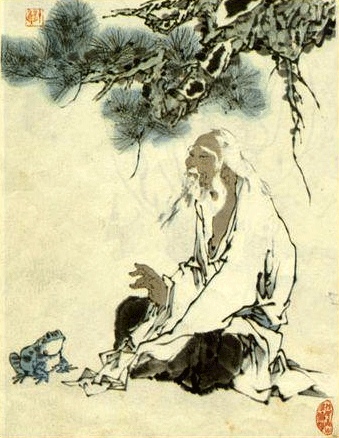
The Paradox of Abundance in Emptiness
Chuang Tzu's assertion, "To have less is to gain," invites us to reconsider our relationship with material possessions and the very essence of fulfillment. In a world that often equates abundance with success, this paradoxical statement challenges us to explore the deeper dimensions of existence. It suggests that by relinquishing our attachment to the material, we may discover a richer, more profound sense of being. This exploration is not merely philosophical; it holds the potential to transform our lives and our understanding of what it means to truly thrive.
At its core, this quote beckons us to confront the illusions of scarcity and abundance that shape our daily experiences. It encourages a journey inward, prompting us to question the societal norms that dictate our desires and aspirations. In a culture that often glorifies accumulation, Chuang Tzu's wisdom serves as a gentle reminder that true gain may lie in simplicity and the art of letting go. This teaching resonates deeply in our contemporary lives, where the pursuit of more can lead to stress, dissatisfaction, and a sense of disconnection from our true selves.
The image / the metaphor
When we contemplate the phrase "to have less," we are immediately drawn to the imagery of simplicity and the act of shedding burdens. The verbs "have" and "gain" evoke a sense of action and transformation, suggesting that the process of letting go is not merely passive but an active engagement with our inner landscape. The felt sense of this quote is one of liberation; it invites us to envision a life unencumbered by excess, where clarity and peace can flourish in the spaces left behind.
Diving deeper into the metaphor, we can see that "less" does not simply refer to material possessions but extends to emotional and psychological attachments as well. It speaks to the idea of decluttering our minds and hearts, creating room for new insights and experiences. In this light, the act of gaining becomes an enriching process of self-discovery, where we learn to embrace the beauty of simplicity and the profound joy that arises from a life lived with intention and mindfulness.
In the speaker's tradition
Chuang Tzu's teachings are deeply rooted in the Taoist tradition, which emphasizes harmony with the Tao, or the fundamental nature of the universe. This philosophy aligns closely with concepts such as *wu wei*, or effortless action, and *sunyata*, the emptiness that allows for the fullness of existence. By advocating for a life of simplicity, Chuang Tzu echoes the Taoist belief that true wisdom lies in understanding the interconnectedness of all things and recognizing that our attachments often lead to suffering.
In the *Zhuangzi*, the text attributed to Chuang Tzu, we find numerous anecdotes illustrating the value of embracing simplicity and the folly of excessive desire. One poignant story involves a man who, upon losing his wealth, discovers a deeper sense of freedom and joy in his newfound simplicity. This narrative encapsulates the essence of Chuang Tzu's philosophy, revealing that the relinquishment of material concerns can lead to a more profound and authentic existence.
Living the teaching
Consider a modern scenario where the teaching of "to have less is to gain" resonates profoundly: the experience of decluttering one's living space. As individuals sift through their belongings, they often encounter a mix of nostalgia and attachment. However, as they let go of items that no longer serve them, they may find a renewed sense of clarity and peace. This physical act of simplification can lead to a mental and emotional lightness, illustrating how the process of having less can indeed yield a greater sense of well-being.
Another application of this teaching can be found in relationships. In moments of conflict or emotional turmoil, we may cling to grievances or expectations, believing that holding onto these feelings will protect us. Yet, by practicing forgiveness and letting go of past hurts, we create space for deeper connections and understanding. In this way, the act of relinquishing emotional baggage can lead to richer, more fulfilling relationships, embodying Chuang Tzu's wisdom in our daily interactions.
A reflection
As we contemplate Chuang Tzu's profound statement, we are invited to reflect on our own lives: What attachments or desires are we clinging to that may be hindering our growth? In what ways can we embrace simplicity to uncover a deeper sense of fulfillment? This inquiry encourages us to engage with the paradox of gain through loss, inviting us to explore the transformative power of letting go in our own journeys.



Join the BrightStar Community
Stay connected with daily inspiration, event announcements, and community wisdom