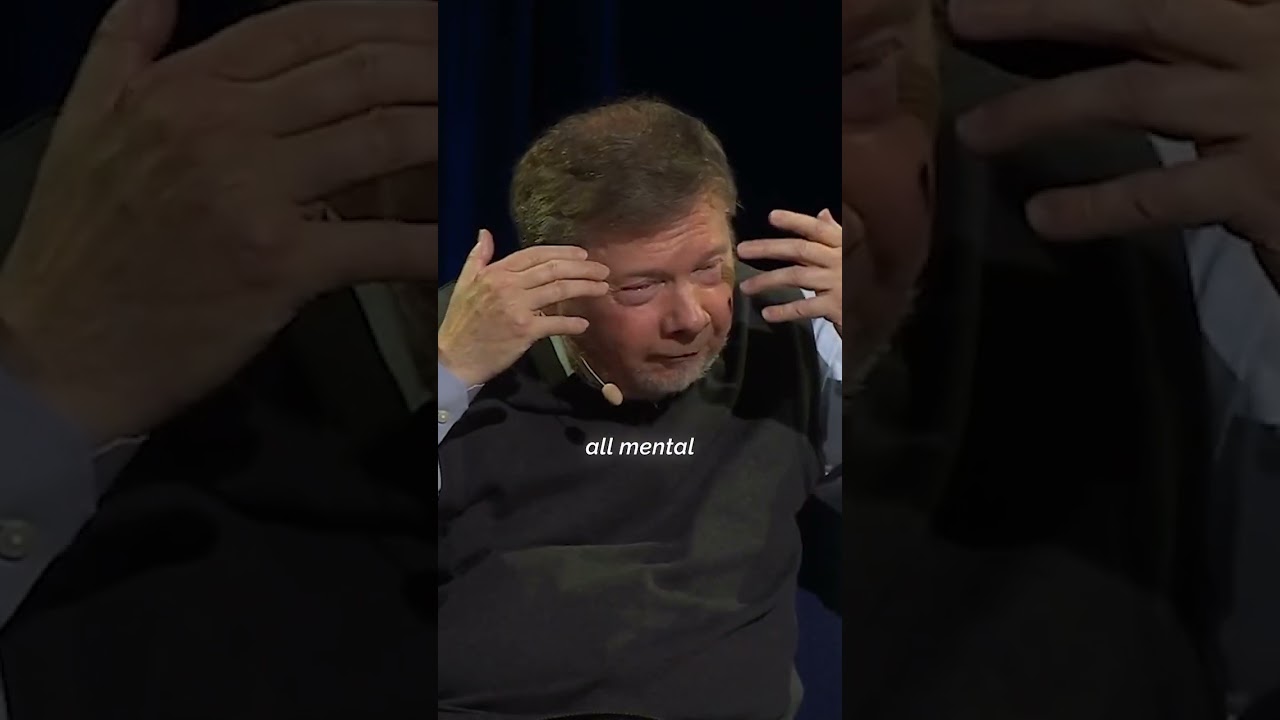
Eckhart Tolle examines the paradox at the heart of organized religion: how the same traditions that can awaken deeper understanding often become imprisoned by ego-driven dogma, conceptual thinking, and the human need for certainty. Rather than dismissing religion entirely, Tolle points toward the quiet, non-conceptual truth that has always existed at the core of every genuine spiritual tradition—a truth that precedes belief systems and survives their distortion.
What Is Religion's Primary Problem?
Religion, in Tolle's analysis, faces a fundamental crisis of form and essence. Religious institutions and belief systems are constructed from concepts—words, doctrines, dogmas, and rules meant to codify spiritual experience and transmit it across generations. Yet the essence of spiritual truth is non-conceptual. It cannot be fully captured by language or belief. This creates an inherent tension: the moment a religion crystallizes into fixed doctrine, it begins to obscure the very truth it originally emerged to convey.
Tolle identifies ego as the primary force that corrupts religion at this junction. When belief systems become weapons for establishing superiority, markers of identity, or tools for social control, they have been thoroughly colonized by ego-consciousness. The believer then becomes attached not to direct spiritual insight but to the correctness of the belief itself. This attachment creates defensiveness, judgment of those outside the tradition, and ultimately a separation from the actual presence and peace that authentic spirituality offers.
The irony Tolle emphasizes is that religions emerge from genuine mystical insight—from individuals or communities who experienced profound truth directly. Yet over time, the institutions built around these insights often become obstacles to that same direct experience. The map (doctrine) becomes mistaken for the territory (lived reality).
How Do Belief Systems Limit Spiritual Growth?
When religion becomes primarily a matter of belief rather than direct experience, it becomes a tool of the thinking mind rather than an opener to presence. Tolle points out that belief is conceptual—it requires you to accept certain propositions about reality, God, afterlife, morality, or practice. Yet the deepest truths of existence cannot be believed into being. They must be accessed through direct perception, through the quality of consciousness itself, through being present.
A person can hold perfect orthodox beliefs and remain entirely asleep to presence. Conversely, someone outside any religious framework can be deeply awake. This reveals the distinction: belief systems can point toward truth, but the pointing is not the arrival. Too often, people mistake doctrinal correctness for spiritual attainment. They achieve inner identification with the belief system—pride in being the "right" religion, superiority over those who believe differently—and this very identification keeps them locked in ego-consciousness.
Furthermore, belief systems impose pre-packaged meaning on experience rather than allowing meaning to arise fresh from direct encounter with what is. When someone experiences loss, joy, or existential questioning, the religious framework provides ready-made answers rather than inviting them into the spaciousness of not-knowing. This pre-digested spirituality can prevent the very disorientation and surrender that opens the door to deeper understanding.
Can Religion Point Toward Genuine Truth?
Tolle does not dismiss religion wholesale. Instead, he makes a crucial distinction: at the core of every genuine spiritual tradition lies a seed of direct truth. This truth emerges when founders or realized individuals access states of consciousness that transcend conceptual thinking—moments of unity, peace, timelessness, or dissolution of ego boundaries. In these moments, they glimpse something real about the nature of existence and consciousness itself.
When a Buddha, Jesus, Rumi, or other spiritual figure attempts to transmit this insight, they use the only tools available: language, metaphor, ritual, and community structure. For a time, particularly while the living presence of realized teachers shapes the tradition, the pointing remains relatively uncorrupted. Followers practice with the intent of accessing the same direct experience. However, over generations, as the original spark of direct insight grows distant and the institution becomes established, the form hardens. The belief system becomes an end in itself.
Yet beneath all this accumulation of doctrine, ritual, and cultural costume, something genuine may still be present. A person sincere in their practice—one who uses the tradition as a genuine aid to presence and not as an identity marker—may touch the same truth the founder touched. The method may be obscured by distortion, but it is not entirely lost.
What Is the Quiet Truth Beneath All Traditions?
Tolle points to a shared discovery across diverse traditions, despite their surface differences: the recognition that ordinary consciousness—the constant stream of thinking, self-reference, and egoic seeking—is not the deepest mode of awareness available to humans. Beneath or beyond this mental activity lies presence itself: a quality of awareness that is spacious, non-judgmental, aware without needing to think about what it is aware of, at peace even in difficulty.
This discovery, though expressed through vastly different concepts and languages, appears across Zen, Advaita, Christian mysticism, Sufism, and other traditions. Some call it enlightenment; others call it union with God; still others call it Buddha-nature or the True Self. The conceptual frameworks differ radically, yet they point toward a shared insight: that beyond the egoic mind lies a mode of being that is both more real and more fulfilling than the mental noise most humans take to be consciousness itself.
This quiet truth is not the property of any single tradition. It does not belong to those who believe the right doctrine. It is available to anyone willing to stop mistaking thought for consciousness, to become still enough to notice what actually is, and to allow the presence that is always already here to become apparent. In this sense, genuine spirituality is simultaneously universal and personal—it is accessible to all while being discovered uniquely by each consciousness that awakens to it.
What Happens When Religion Becomes Primarily About Belief?
When institutions prioritize orthodoxy over direct experience, belief becomes a substitute for presence. A person may spend decades in religious practice—prayer, worship, study, ritual—while remaining identified with the egoic self and its patterns. The belief system can even reinforce ego by providing a vehicle for righteousness, superiority, or tribal belonging. Religious certainty can be particularly seductive because it promises to answer the deepest questions, to provide ultimate meaning, and to belong to the "right" group.
This shift from experience to belief creates a particular vulnerability: the person becomes invested in defending the beliefs, which means defending the ego-structures attached to them. Any challenge to the doctrine feels like a threat to the self. This explains why religious disagreements so often become hostile, why religious communities can harbor remarkable cruelty toward those who question or leave, and why genuine spiritual transformation often requires breaking away from inherited religious certainty.
Tolle suggests that authentic religion—if such a thing can exist in institutional form—would prioritize the direct knowing of presence above all doctrinal correctness. It would use belief and practice as scaffolding to support the awakening of consciousness, not as an end point in themselves. The moment the scaffolding becomes the goal, the religion has become an obstacle.
How Can Religion Serve Rather Than Hinder?
For those who find themselves within a religious tradition, or drawn to one, Tolle implies a straightforward test: Does this practice, belief, or community draw you closer to presence and peace? Does it dissolve the boundaries between you and others, revealing the shared consciousness underneath different forms? Or does it reinforce identity, separation, and the importance of being right?
A genuine spiritual practice—whether within or outside religious form—works to dissolve the false separation between self and world, to quiet the incessant mental commentary, to open compassion for all beings, and to reveal the timeless awareness that is your deepest nature. If a religious teaching serves these ends, it has value. If it serves to strengthen the ego while claiming to serve spirit, it has been corrupted regardless of how orthodox it appears.
This means that a sincere atheist practicing genuine presence, compassion, and non-identification with thought may be far more aligned with spiritual truth than an orthodox believer clinging to doctrine for identity and security. The form matters far less than the actual quality of consciousness it produces in the practitioner.
Where to go from here
If you find yourself wrestling with religion—whether you remain within a tradition, have left one, or never belonged to one—Tolle suggests moving the locus of evaluation from intellectual belief to direct experience. Notice where presence and peace actually arise in your life. Notice when thinking makes you contract and when stillness makes you expand. Watch how identification with belief creates conflict and how letting beliefs go creates freedom. Use any teaching, practice, or tradition as a raft to cross the river of consciousness, but do not mistake the raft for the destination shore. The real test of any spiritual path is not its doctrinal purity but its capacity to awaken you to the presence that you actually are, beneath all conceptual identity.