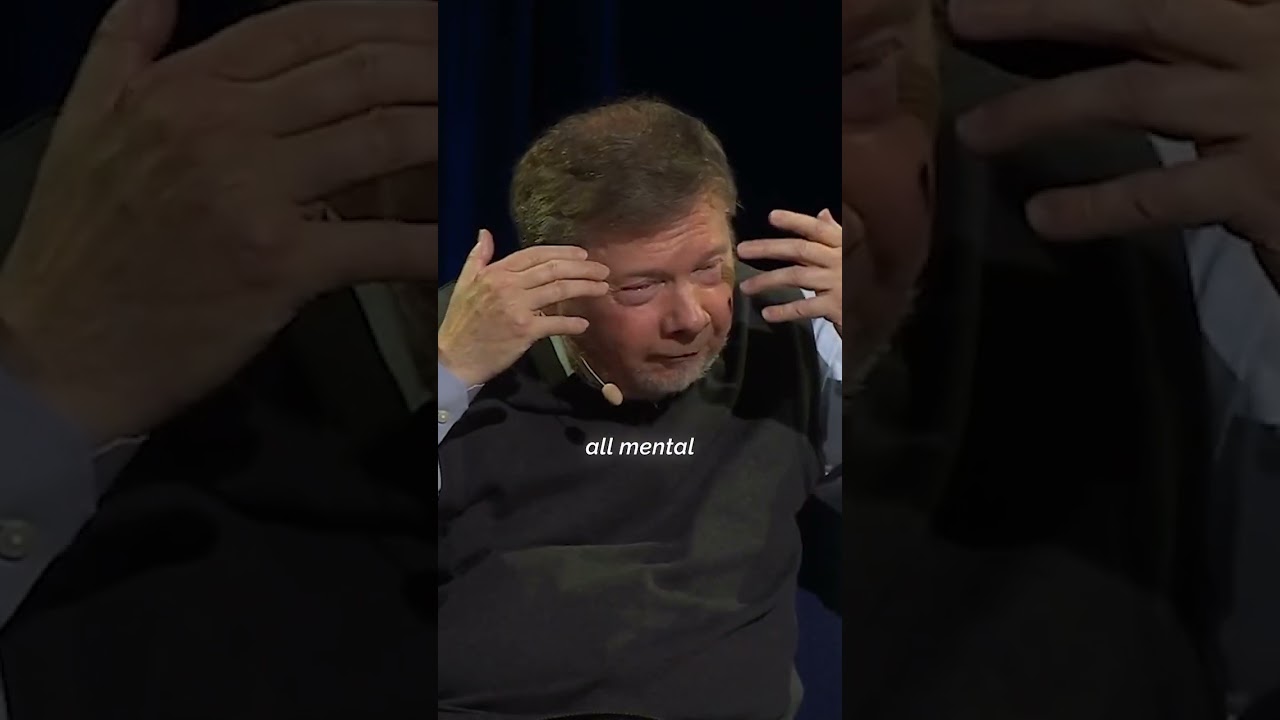
Eckhart Tolle teaches that the fundamental misunderstanding at the root of human suffering is the belief that we are isolated "persons" separate from life itself. In reality, consciousness is not something *you have* but something you *are*—the very awareness through which the universe experiences its own being. By releasing identification with the thinking mind and the constructed self, we awaken to our true nature as presence itself, which brings a deep stillness and joy that no personal achievement can match. This shift is not philosophical abstraction but a direct realization that dissolves the sense of separation and reveals our intrinsic oneness with all existence.
What Does It Mean to Be Presence Rather Than a Person?
At the heart of Tolle's teaching lies a radical distinction: most people live from the assumption that they *are* a person—a separate, bounded self with a history, identity, and set of characteristics. This person-self is largely constructed from thoughts, memories, and the stories we tell about ourselves. But beneath and prior to this mental construct is something more fundamental: consciousness itself, which Tolle calls "presence."
Presence is not something you achieve or acquire. It is the immediate, aware aliveness that exists right now, prior to all thought and judgment. When you truly sense this presence—not as an idea but as a lived reality—the rigid boundary between "you" and "everything else" begins to dissolve. You begin to recognize that the awareness in which your experience arises is the same awareness present in all beings and things. This is not metaphorical. The consciousness through which you see, hear, and feel is the universe itself becoming aware of itself through your eyes.
The shift from person to presence is therefore a fundamental reorientation in how you relate to existence. Instead of being a separate entity struggling against life, you discover that you *are* life, expressing itself in this particular form. This realization brings an end to the exhausting effort of trying to secure, protect, and defend a self that was never solid to begin with.
How Does the Illusion of Being a Separate Person Create Suffering?
The belief that you are a separate person generates a baseline of anxiety and striving that colors all human experience. If you are indeed a separate self in a universe that does not inherently care about your survival or happiness, then existence becomes fundamentally precarious. You must constantly work to acquire what you need, protect what you have, and defend against threats both external and internal. This creates a perpetual sense of lack, urgency, and inadequacy.
From this false sense of separation flows every strategy of the ego: the endless pursuit of more, the need to be special or superior, the fear of death and loss, the resentment toward others who seem to have what you lack. All of these arise because the separate person is, by definition, in competition with everything else for survival and validation. There is never enough time, never enough resources, never enough recognition. The game is rigged because the premise is false.
When you live primarily in thought—identifying with the content of your mind rather than the awareness in which thoughts appear—you reinforce this illusion of separation at every moment. Thought divides reality. It labels, categorizes, judges, and creates the sense of a subject (you) observing objects (everything else). Even when you think about connection or unity, these are still just thoughts—they do not necessarily penetrate to the actual realization that you are already not separate.
What Is the Deep Joy That Arises When the Illusion Dissolves?
Tolle points to something that cannot be manufactured or earned: a joy and stillness that emerges naturally when the constant struggle of maintaining a separate self ceases. This is not happiness, which depends on external circumstances. It is a intrinsic okayness with what is, a recognition that existence itself is fundamentally whole and complete.
When you stop trying to be the person you think you should be—or to become the person you want to become—an enormous amount of psychological energy is freed. No longer are you dividing your attention between what is happening and your inner commentary about whether it is good, bad, fair, or aligned with your personal narrative. You are simply present with what is, and in that simplicity, there is a rightness that the thinking mind cannot grasp.
This presence is not inert or passive. It is the source of genuine action and intelligence. But action flows from presence rather than from the anxious calculations of the separate self. Decisions arise from clarity rather than fear. Responses are appropriate to what is actually needed, not filtered through layers of personal desire and defensiveness. And because you are no longer primarily concerned with how things affect *you*, you naturally become more responsive to the needs of others and the world.
How Can You Directly Experience the Shift From Person to Presence?
Tolle consistently emphasizes that this is not a matter of belief or intellectual understanding. It is a shift in where your attention rests. The practice involves directing awareness away from the content of thought (the story of who you are) toward the awareness itself—the simple, immediate sense of being alive right now.
One approach is to notice the gaps between thoughts. Even for a brief moment, there is a space where no thought is occurring, yet awareness continues. In that space, there is no sense of being a person, no narrative of self, only a simple aliveness. By returning attention to this state, again and again, the identification with thought begins to loosen its grip.
Another entry point is sensory awareness. Rather than being lost in thinking about your experience, you can drop into the simple reality of what you are sensing right now: the feeling of breath, the sounds around you, the texture of objects you touch. This grounds attention in the present, where the only thing that exists is this immediate aliveness. The person, with its entire history and identity, is revealed as an overlay on top of what is actually here.
Tolle also points to the experience of being in nature or witnessing beauty. When confronted with something vast or moving, the usual preoccupation with the self often falls away. You are simply absorbed in what you are perceiving. In those moments, the boundary between observer and observed becomes less distinct. The consciousness with which you see the beauty is part of the beauty itself.
What Is Oneness, and How Does Realizing It Change Your Life?
Oneness is not a state of blissful merger where all individuality dissolves. Rather, it is the recognition that beneath all the apparent separation and diversity of form, there is a single consciousness expressing itself through infinite variations. You remain an individual form—unique patterns of mind and body in time and space—but you are no longer identified exclusively with that form. You know yourself as the awareness that animates all forms.
This realization fundamentally alters how you relate to other people and situations. If the consciousness that looks out through your eyes is the same consciousness that looks out through all eyes, then harming others is harming yourself, and helping others is helping yourself. This is not sentimental or wishful thinking. It is a direct implication of the oneness that becomes apparent when the false boundary of the separate self is seen through.
At the same time, oneness does not mean that individual responsibility, discernment, or healthy boundaries disappear. You still function as a particular person in time, making choices and living a life. But you do so from a foundation of wholeness rather than from the fragmentation of separation. You no longer desperately seek meaning or validation because you recognize that you are already whole, already a direct expression of existence itself.
In practical terms, living from oneness brings a radically different quality to relationships, work, and decision-making. You are no longer primarily motivated by personal gain or fear. You are motivated by what is needed in the moment. You respond to others from genuine care rather than from a need to be liked or to control outcomes. You work with full engagement but without anxious attachment to success or failure.
Why Does Tolle Emphasize That We Are Life Itself?
This point is central to Tolle's teaching because it corrects a fundamental error in how humans understand their place in existence. The common assumption is that you are a small, separate consciousness confined to a body, living inside a vast, largely indifferent universe. This view is both scientifically and spiritually inaccurate.
In fact, the consciousness that experiences your life is not confined to your brain or body. Consciousness is fundamental to reality itself. What you call "your consciousness" is a localized expression or manifestation of universal consciousness. You are not a consciousness trapped in matter. Rather, you are matter and energy organized in a way that allows consciousness to be aware of itself through this particular form.
When Tolle speaks of being "life itself," he is pointing to the direct experience of this truth. In the present moment, life is actually happening. Breathing is happening. Sensing is happening. Awareness is happening. When you are fully present to this, you recognize that you are not separate from it. You are the process itself. Life is not something that happens *to* you; it is what you are.
This shifts the entire orientation of practice and awakening. Instead of trying to improve yourself or become something other than what you are, the invitation is simply to be aware of what is already true. You are already the consciousness through which existence experiences itself. The only question is whether you recognize this or continue to believe yourself to be a limited, separate self.
Where to Go From Here
The insights in Tolle's teaching are not meant to remain as intellectual ideas. True understanding comes through direct experience, through a repeated turning of attention away from thought and toward the awareness in which all experience arises. This can be practiced in any moment: through stillness and meditation, through mindful presence in daily activities, through receptive awareness of nature, or through genuine presence with others.
The shift from identifying as a person to resting as presence is gradual for most. Habits of mind are deep and persistent. But each moment in which you recognize your true nature as awareness itself, rather than as the contents of your mind, is a moment of awakening. And as these moments accumulate, they begin to restructure your entire experience of being alive. The world does not need to change for this to happen. Only your sense of who and what you are needs to shift—and that shift is available right now, in this very moment, as you read these words.