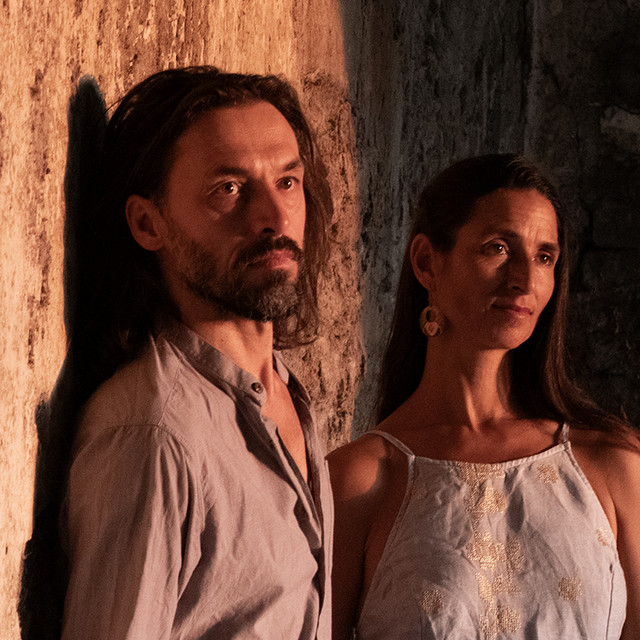
Mirabai Ceiba and collaborators Tina Malia, Gonzalo Paniagua, and Raffa Martinez perform "Agua de Luna" (Water of the Moon), a devotional kirtan piece that merges Sanskrit mantra traditions with contemporary world music arrangements. The performance showcases the healing and meditative power of call-and-response singing, rhythmic instrumentation, and the practice of kirtan as a gateway to presence and embodied spirituality.
What is Agua de Luna and Its Spiritual Roots?
"Agua de Luna" translates as "Water of the Moon" and represents a contemporary expression of kirtan—the practice of singing sacred mantras and devotional songs in call-and-response form. This particular piece draws on both Hindu-Sanskrit traditions and Spanish/Latin American musical sensibilities, creating a bridge between Eastern spiritual practices and Western musical contexts. The title itself carries metaphorical weight: water as a symbol of flow, fluidity, and emotional depth, while the moon traditionally represents the receptive, reflective, and intuitive dimensions of consciousness in yoga and Ayurvedic philosophy.
Kirtan as a practice dates back centuries in Hindu devotional traditions, where it serves as a method of congregational chanting meant to elevate consciousness and cultivate bhakti (devotion). In the modern context that Mirabai Ceiba practices and teaches, kirtan becomes a vehicle for cross-cultural spiritual dialogue—weaving together global musical traditions while maintaining the core intention of connecting participants to a state of meditative awareness and emotional healing.
How Does Call-and-Response Singing Create Spiritual Experience?
The structure of kirtan relies fundamentally on call-and-response, a participatory format where one voice (or group of voices) sings a phrase, and the gathered community responds with the same or complementary phrase. This dynamic creates multiple layers of spiritual engagement. First, it removes the hierarchical distance between teacher and student—everyone is both a witness and a participant in the song. Second, the repetition of simple mantras or phrases allows the thinking mind to settle, as consciousness focuses on the vibratory quality of sound rather than conceptual meaning.
In "Agua de Luna," Mirabai Ceiba's voice leads, with Tina Malia and other musicians joining in harmonic layers that create a rich, multi-textured sonic environment. This approach deepens the meditative effect: listeners or singers find themselves supported by multiple vocal lines, each resonating at different frequencies and creating what practitioners describe as a felt sense of expansion or interconnection. The live ensemble format—with Gonzalo Paniagua on percussion and Raffa Martinez contributing additional instrumentation—anchors the vocals in rhythmic stability, allowing singers to relax into the groove rather than maintain pitch or timing independently.
What Role Does Vocal Healing Play in Kirtan?
Both Mirabai Ceiba and Tina Malia are known for their understanding of the voice as a healing instrument. In traditional Ayurvedic medicine and yoga, sound (shabda) is considered one of the five subtle elements, and specific tones and mantras are believed to balance the nervous system, open energy channels (nadis), and unlock emotional blockages stored in the body. The voice, when used intentionally and with awareness, becomes a tool for this healing work.
When singing devotional music like "Agua de Luna," practitioners often report experiences of emotional release, deepened breathing, and a sense of connection or unity. This is not merely psychological—research into sound healing and chanting has documented measurable shifts in heart rate variability, cortisol levels, and brain wave patterns during and after kirtan practice. The repetitive structure, combined with the harmonic frequencies of multiple voices, creates an entrainment effect where the body's rhythms synchronize with the sonic environment. For participants and listeners, this can feel like a permeable boundary between self and environment dissolving, which many describe as a spiritual or transcendent experience.
How Do World Music Elements Enhance the Traditional Kirtan Form?
Mirabai Ceiba's signature approach involves integrating Latin American and world music instrumentation into the classical kirtan framework. "Agua de Luna" exemplifies this fusion: while the devotional intention and call-and-response structure remain rooted in Sanskrit traditions, the arrangement incorporates rhythmic patterns, melodic sensibilities, and instrumental colors from broader global contexts. Gonzalo Paniagua's percussion work, for instance, likely includes both traditional Indian rhythmic cycles (talas) and Latin percussion textures, creating a polyrhythmic environment that feels both grounding and expansive.
This cross-cultural approach serves a practical and spiritual purpose. For Western and global audiences less familiar with Sanskrit mantras or Hindu devotional aesthetics, the integration of familiar musical elements lowers the barrier to entry while preserving the depth and intention of the practice. Additionally, it reflects the reality of contemporary spiritual seekers, who often draw wisdom and practices from multiple traditions. By honoring both roots, Mirabai Ceiba models what intercultural spirituality might sound like—not diluted or superficial, but genuinely rooted and respectfully adaptive.
What Happens in the Body and Mind During Live Kirtan Performance?
The live format of "Agua de Luna" creates distinct advantages over recorded or solitary practice. The presence of other human voices and the real-time responsiveness between musicians and audience generates a shared field of attention and intention. Neuroscientific research on group singing has shown that synchronized vocalization strengthens social bonding, increases oxytocin (the "bonding hormone"), and creates measurable synchronization between participants' nervous systems.
For those singing along with Mirabai Ceiba and the ensemble, the experience typically unfolds in stages. In the opening moments, conscious attention focuses on following the melody, matching pitch, and coordinating with others' voices. As repetition deepens, the critical mind often quiets—there is less "trying to get it right" and more flowing with the established pattern. At this point, many practitioners report a shift into what meditators call "witness consciousness," where awareness becomes spacious and non-judgmental. Some experience emotional release; others describe a state of timelessness or connection. Physiologically, this correlates with a shift from sympathetic nervous system activation (the thinking, vigilant state) toward parasympathetic dominance (the rest, digest, and healing state).
Why is the Moon Symbolism Significant in Devotional Practice?
The moon has held spiritual significance across cultures for millennia. In yoga and Tantric philosophy, the moon is associated with shakti (divine feminine energy), receptivity, the cooling and calming aspects of consciousness, and the subtle energy channels of the body. The left nadi (energy channel) is often called "Ida" and associated with lunar qualities—introspective, intuitive, nurturing. In many spiritual traditions, the full moon is a time of heightened spiritual practice, when the veil between inner and outer worlds is considered particularly thin.
By titling the piece "Agua de Luna" (Water of the Moon), Mirabai Ceiba invokes these associations while also suggesting flow, receptivity, and emotional depth. Water itself symbolizes adaptability and the dissolution of rigid boundaries—qualities sought in meditation and spiritual awakening. Together, the imagery points to a state of consciousness that is both reflective and fluid, both grounded in the body and open to transcendent experience. For practitioners and listeners, this symbolic resonance can deepen their felt connection to the song's intention and their own inner work.
How Can Listeners Deepen Their Engagement with Kirtan?
For those new to kirtan or encountering "Agua de Luna" for the first time, deepening engagement often begins with surrender to the repetition rather than intellectual analysis. Kirtan is not primarily a cognitive practice—the meaning of individual Sanskrit words, while valuable, is secondary to the vibratory and meditative effects of singing or listening. A practical approach is to listen with closed eyes, allowing the voice to guide attention inward. Many practitioners focus on the heart center or follow the movement of breath synchronized with the melody.
In a live setting like the performance captured in this recording, singers are invited to join vocally in the response portions of the call-and-response. This active participation intensifies the healing and meditative benefits. Even without Sanskrit knowledge, following Mirabai Ceiba's lead and repeating phrases creates a direct channel to the practice's intention. Some listeners prefer to remain silent and receive the sound; this too is valued in the kirtan tradition, as the vibrations of others' voices can work on subtle levels of consciousness without the need for active vocal participation.
Where to Go from Here
Those drawn to "Agua de Luna" might explore other recordings by Mirabai Ceiba and Tina Malia to understand how their collaborative approach to kirtan evolves across different pieces and themes. Studying the Sanskrit terms and their meanings—if present in the song's lyrics—can add intellectual depth to the practice. Additionally, seeking out live kirtan events or satsang (spiritual gatherings) in one's local area offers the embodied, communal dimension that makes kirtan such a potent practice. Resources on yoga nidra (yogic sleep), pranayama (breath work), and basic Ayurvedic understanding of sound and the elements can further contextualize why a practice like kirtan affects the body and mind so measurably. Finally, experimenting with personal kirtan practice—singing alone or with a small group—can reveal how this ancient form continues to serve contemporary spiritual seekers seeking healing, connection, and direct experience of consciousness beyond thought.


