The Harmony of Right and Wrong: A Sage's Perspective
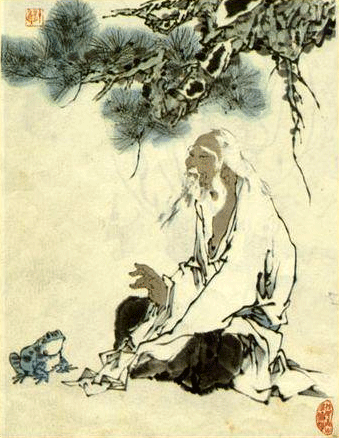
Chuang Tzu's assertion that "the sage harmonizes the right and the wrong, and rests in heaven the equalizer" invites us to contemplate the delicate balance between opposing forces in our lives. This quote speaks to the essence of equanimity, suggesting that a true sage does not merely choose one side over the other but instead finds a way to integrate both. In a world often polarized by moral absolutism, this teaching offers a profound reminder of the complexity of existence and the wisdom that comes from embracing duality.
At its core, this quote challenges us to reconsider our own judgments and biases. The sage, as depicted by Chuang Tzu, embodies a state of being that transcends conventional notions of right and wrong. By resting in "heaven," the sage achieves a perspective that allows for a more expansive understanding of life, one that recognizes the interconnectedness of all things. This perspective is not merely philosophical; it has practical implications for how we navigate our relationships, decisions, and inner conflicts.
The image / the metaphor
The imagery in Chuang Tzu's quote evokes a sense of balance and tranquility. The act of harmonizing right and wrong suggests a dynamic interplay rather than a static resolution. The verbs "harmonizes" and "rests" imply a gentle, ongoing process of integration, where the sage actively engages with life's complexities while maintaining a serene disposition. The phrase "heaven the equalizer" conjures an image of a higher state of consciousness, one that transcends earthly dichotomies and embraces a more holistic view of existence.
Diving deeper into the metaphor, we can see that the "sage" represents not just an individual but an archetype of wisdom that exists within each of us. To harmonize right and wrong is to acknowledge that life is rarely black and white; it is a spectrum of experiences and emotions. The sage's resting in heaven signifies a state of inner peace that arises from this understanding, suggesting that true wisdom lies in the acceptance of life's inherent contradictions. This metaphor invites us to cultivate a similar state of being, where we can navigate our own moral landscapes with grace and understanding.
In the speaker's tradition
Chuang Tzu's teachings are deeply rooted in the Taoist tradition, which emphasizes the importance of living in harmony with the Tao, or the fundamental nature of the universe. Concepts such as wu wei, or effortless action, resonate with the idea of the sage harmonizing right and wrong. In Taoism, the pursuit of balance is paramount, and the sage embodies this principle by navigating the complexities of life without attachment to rigid moral judgments. This approach aligns with the Buddhist notion of sunyata, or emptiness, which encourages us to see beyond dualistic thinking and embrace the fluidity of existence.
In the text of the Zhuangzi, we find numerous anecdotes that illustrate the sage's ability to transcend conventional wisdom. For instance, the story of the "butterfly dream" serves as a poignant reminder of the fluidity of identity and the interconnectedness of all beings. Just as the sage in Chuang Tzu's narrative navigates the dream state with ease, we too are invited to explore the boundaries of our own perceptions and judgments. This exploration can lead to a deeper understanding of ourselves and the world around us, fostering a sense of compassion and acceptance.
Living the teaching
Consider a modern scenario where this teaching might resonate: a workplace conflict where colleagues are divided over a project direction. One person advocates for a strict adherence to protocol, while another pushes for innovation and flexibility. In this situation, embodying the sage's wisdom would involve recognizing the merits of both perspectives and seeking a collaborative solution that honors the strengths of each approach. By harmonizing these differing viewpoints, the team can move forward with a sense of unity and purpose, rather than being mired in discord.
Another application of this teaching can be found in personal relationships, particularly during moments of disagreement. Imagine a couple facing a significant decision, each holding strong opinions that seem irreconcilable. By embodying the sage's approach, they can create a space for open dialogue, allowing each partner to express their views while also seeking common ground. This practice of harmonizing right and wrong fosters deeper intimacy and understanding, transforming conflict into an opportunity for growth and connection.
A reflection
As we reflect on Chuang Tzu's profound insight, we might ask ourselves: In what areas of my life am I clinging to rigid notions of right and wrong? This contemplative question invites us to explore the ways in which our judgments may limit our understanding and relationships. By embracing the wisdom of the sage, we can cultivate a more expansive view of life, one that honors the complexities of our experiences and fosters a deeper sense of peace and connection with ourselves and others.



Join the BrightStar Community
Stay connected with daily inspiration, event announcements, and community wisdom