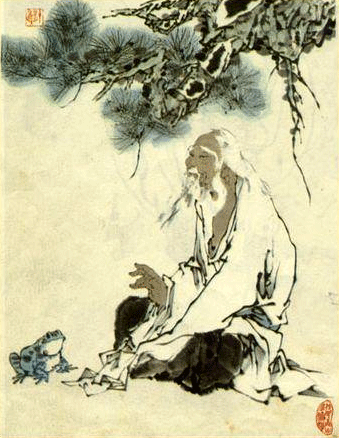
The Freedom of Natural Existence
Chuang Tzu's assertion that "the natural condition of life is to be without anxiety" invites us to reconsider our relationship with the world and ourselves. In a society often characterized by stress and worry, this statement serves as a profound reminder of our innate state of being. It suggests that anxiety is not a fundamental aspect of existence, but rather a distortion that arises from our disconnection from nature and our true selves. Understanding this can lead to a transformative shift in how we navigate our lives.
Delving deeper, we find that Chuang Tzu's wisdom encourages us to embrace a life of simplicity and spontaneity, free from the burdens of societal expectations and self-imposed limitations. This perspective is not merely philosophical; it is a call to return to a more authentic way of living, one that aligns with the rhythms of nature. By recognizing that anxiety is an aberration rather than a norm, we can begin to cultivate a sense of peace that is inherent to our being, allowing us to flourish in the present moment.
The image / the metaphor
At the heart of Chuang Tzu's quote lies a vivid metaphor that evokes the essence of naturalness. The term "natural condition" conjures images of flowing rivers, untroubled skies, and the effortless growth of trees. These elements of nature exist without the weight of anxiety; they simply are. The verbs chosen—"to be without"—imply a state of existence that is not contingent upon external circumstances but is instead a fundamental aspect of life itself. This imagery invites us to envision a life where we are unencumbered by the anxieties that often plague our minds.
Going deeper, the metaphor suggests that just as nature thrives in its authenticity, so too can we. The absence of anxiety is not merely a passive state; it is an active engagement with life that allows us to respond to challenges with grace and ease. This perspective encourages us to cultivate a sense of trust in the unfolding of our lives, much like a seed trusts the soil to nurture its growth. By embracing this metaphor, we can begin to see anxiety as an artificial construct that disrupts our natural flow.
In the speaker's tradition
Chuang Tzu's teachings are deeply rooted in the Taoist tradition, which emphasizes the importance of living in harmony with the Tao, or the natural way of the universe. This philosophy resonates with concepts such as wu wei, or effortless action, which encourages individuals to align their actions with the natural flow of life rather than forcing outcomes. In this context, anxiety can be seen as a resistance to the Tao, a struggle against the inherent rhythms of existence that leads to suffering and discontent.
In the text of the Zhuangzi, we find numerous anecdotes that illustrate the folly of striving against nature. One such story involves a fish that is caught in a net, struggling against its fate. The fish's anxiety only serves to exacerbate its predicament, while acceptance of its situation would lead to a more peaceful existence. This narrative serves as a poignant reminder that by relinquishing our need to control and instead embracing the natural course of life, we can find true freedom and tranquility.
Living the teaching
Consider a modern scenario where the pressures of work and life create a pervasive sense of anxiety. Many individuals find themselves caught in a cycle of overthinking, striving for perfection, and fearing failure. In this context, Chuang Tzu's teaching offers a liberating perspective. By recognizing that the natural condition of life is to be without anxiety, one can begin to let go of the need for constant achievement and instead focus on being present. This shift can lead to a more fulfilling and balanced approach to work and personal life, allowing for creativity and joy to flourish.
In relationships, the teaching can manifest in a different yet equally profound way. Imagine a moment of conflict with a loved one, where anxiety about the outcome clouds communication and understanding. By embracing the idea that anxiety is not a natural state, one can approach the situation with a sense of calm and openness. This allows for authentic dialogue and connection, fostering a deeper bond that transcends the immediate tension. In daily practice, cultivating mindfulness and self-awareness can support this teaching, helping individuals to recognize anxious thoughts as they arise and gently guide themselves back to a state of natural ease.
A reflection
As we contemplate Chuang Tzu's assertion, we are invited to reflect on our own lives and the anxieties we carry. What would it mean to live in alignment with our natural condition, free from the burdens of worry? Consider this contemplative question: In what areas of your life do you feel the weight of anxiety, and how might you begin to release that burden in favor of a more authentic existence? Allow this inquiry to guide you toward a deeper understanding of your relationship with the natural flow of life.



Join the BrightStar Community
Stay connected with daily inspiration, event announcements, and community wisdom