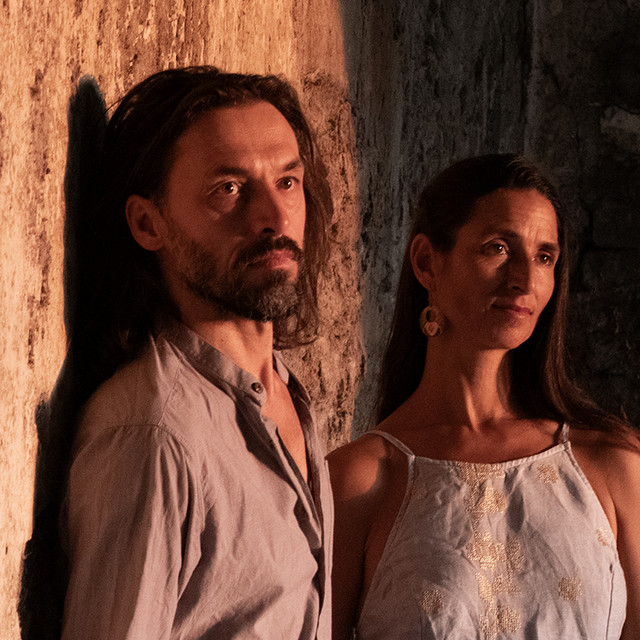
In "She," Mirabai Ceiba renders a portrait of the feminine consciousness in communion with the natural world—a woman reaching toward dawn's secrets, listening to silence, and surrendering the illusion of self to inhabit the freshness of the present moment. The song weaves imagery of wind, stillness, and creation to articulate a spiritual state where the boundaries between observer and observed dissolve, and where the only possession that matters is the key to freedom itself.
What Is "She" About?
"She" is a lyric meditation on feminine awakening and presence. The song follows an unnamed woman as she reaches outward to dawn, seeking revelation. Rather than a narrative arc with plot, the piece functions as a series of sensory and spiritual encounters—the listening woman becoming a vessel for the dialogue between inner silence and outer creation. Mirabai Ceiba uses concrete imagery (dawn, cold wind, thick breath, still windows) to anchor what is ultimately a song about transcending the self and touching the raw texture of being alive.
How Does Silence Function as a Teacher?
In the opening stanza, the woman "listens to the quiet window so still as if listening too." The window becomes a mirror: the listener and the listened-to share the same quality of attention. This reciprocal witnessing suggests that silence is not an absence but an active presence—a teacher that communicates through resonance rather than words. Later, silence is described as "like a thick breath" that "surrounds her and she is full of it too." The comparison to breath dissolves the boundary between the external silence and the woman's interior space. She is not separate from the stillness; she contains it.
What Does It Mean to Forget Who She Was?
The song's turning point arrives with the line "As if forgetting who she was / or who she will be." This forgetting is not loss but liberation. In spiritual practice, particularly in non-dual traditions, the dissolution of the constructed identity—the story of past and future—is understood as a prerequisite for awakening to what is. By releasing the narrative of "who she was" and who she "will be," the woman opens to the present moment, where "the newness of this moment the freshness in her eyes" becomes visible. This is not amnesia but a strategic release of the mind's habitual anchoring to memory and projection.
What Is the Longing Expressed in the Song?
The second half of the lyrics shift from description to yearning: "The longing to unveil / what is now so clear / she can't hold it tight." Here Mirabai Ceiba articulates a paradox central to mystical experience—the object of realization is simultaneously obvious and impossible to grasp. The clarity is so immediate, so present, that the attempt to seize it as an object of knowledge fails. What is revealed is not a secret to be kept but a truth too alive, too fluid to be contained. This longing is not frustrated desire; it is the recognition that some truths can only be lived, not owned.
What Does the Key Represent?
The climax of the song introduces a new image: "She only holds the key / to open the door and go out / into the fresh air and see." This is the sole possession offered—not a treasure, not wisdom stored, but a tool for opening and passage. The key is not the destination; it is what permits movement, freedom, and circulation between inner and outer worlds. By holding only the key, the woman relinquishes the illusion of ownership or control. She becomes a conductor of life rather than its curator.
How Does the Song Describe Relationship to Creation?
The final images pivot toward taste and sensation: "the fruits of time taste / the sweetness of being surrounded / by this raw creation." Mirabai Ceiba moves from visual and auditory awareness to the body's direct participation—tasting, feeling surrounded. The phrase "raw creation" is significant; it points not to nature domesticated or understood through the mind, but creation in its unfiltered aliveness. To be "surrounded" by this rawness is to be held by a force larger than oneself, and to taste its sweetness is to find nourishment in that holding.
How Does the Spanish Version Expand the Meaning?
The song exists in both English and Spanish, a bilingual invitation that itself enacts the themes of openness and passage. In Spanish, "Ella se acerca al amanecer" (She approaches the dawn) and the line "como si olvidara quien ella fue / o quién será" carries the same poetic ambiguity about identity and time. The parallel structure allows listeners in both languages to meet the song where they are, while the repetition across languages suggests that this feminine awakening is not culturally specific but universal in its core recognition.
Where to go from here
Listeners drawn to this song might explore other works by Mirabai Ceiba that blend kirtan tradition with contemporary songwriting and feminine spiritual imagery. The themes of dissolution, presence, and the body's role in awakening can be deepened through non-dual contemplative practice—particularly meditation practices that emphasize listening and the space between thoughts. The image of "holding the key" rather than the treasure invites reflection on spiritual practice itself: Is your work aimed at accumulation or liberation? Are you trying to own the experience or allow it to move through you?