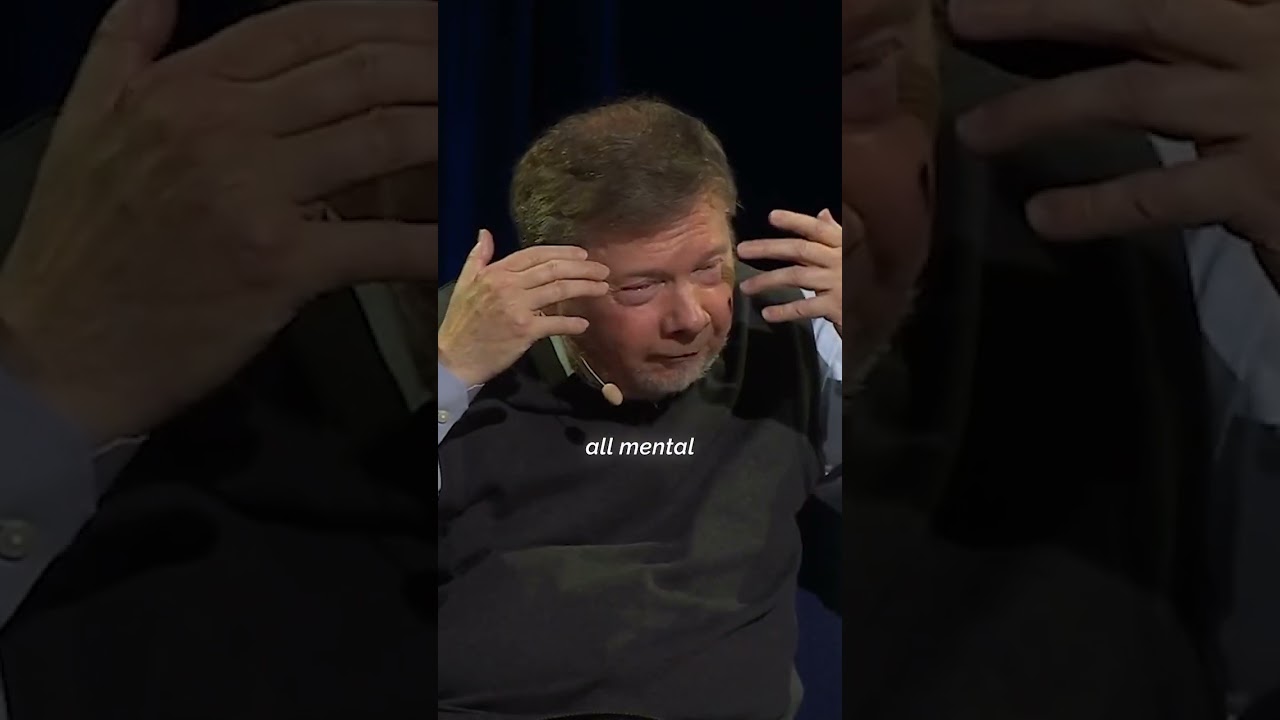
Eckhart Tolle distinguishes between the fear that arises from ego-identification and your true consciousness, which remains untouched by threat. He reframes what we call "failure" not as defeat, but as a necessary step within the larger awakening process. When you understand that you are not the ego structure that fears, you access a dimension of yourself that cannot be harmed.
What Is the Ego's Fear, and Why Doesn't It Touch You?
Tolle's central teaching here turns on a critical recognition: the fear you experience is not your fear. It belongs to the ego—the construct of thought and identity that constantly projects threat and seeks protection. Your true self, your consciousness, your awareness itself, has no stake in the ego's survival drama.
The ego is fundamentally a pattern of thought and identification with form. It defines itself through comparison, achievement, status, and the accumulation of psychological identity. When anything threatens that identity—failure, rejection, loss of control—the ego generates fear. This is its nature. But crucially, this mechanism operates in a dimension separate from what you actually are.
Consciousness—pure awareness—observes the ego's fear without inheriting it. When you notice the fear arising, when you can see it happening, you have already stepped back from it. That noticing itself, that capacity to witness what arises, is closer to what you are than any content of thought or emotion. The ego cannot exist in genuine presence; presence naturally dissolves the identification that sustains the ego structure.
How Does the Ego Create Its Own Suffering?
The ego's fear-generation mechanism is self-perpetuating. It invents scenarios of future loss, it rehashes past wounds, it compares your present moment to an imagined ideal, and it concludes you are inadequate or at risk. This entire narrative runs on thought—on the movement of mind rather than on what is actually happening now.
When you are identified with the ego, you believe these thought-stories completely. You feel their emotional charge as real, as deserved, as required for your survival. But this identification is the source of the suffering, not the content itself. The thought "I failed" becomes devastating only when you believe you are a being that can fail in a permanent, identity-altering way. The thought then triggers shame, fear of judgment, projection of future consequences.
Tolle's insight inverts this: there is no being that fails. There are only moments, situations, outcomes that do not align with your preferences or expectations. These moments are empty of ultimate meaning until you project the ego's story onto them. The ego then uses failure as proof of its fundamental inadequacy—and thus it deepens its fear and its defensive contraction.
Why Is Failure Actually a Step in Awakening?
The reframe in Tolle's teaching is radical. What the ego calls "failure" is, from the perspective of awakening, information and redirection. It is the universe—or your deeper intelligence—showing you that a certain path, strategy, or identification is not serving your true unfoldment.
When you fail at something the ego identified with—a job, a relationship, a project, a self-image—the ego experiences this as catastrophe. But if you can step back from ego-identification even slightly, you see that the failure itself does nothing. It simply happened. The pain comes entirely from the story: "This proves I am inadequate," "I am rejected," "I cannot trust myself," "The future is unsafe."
From the awakening perspective, every perceived failure is an invitation to let go of a false identity. It strips away the illusion that your worth, safety, or existence depends on any particular outcome. In this sense, failure becomes a powerful teacher. It humbles the ego, it breaks its identification with control, and it creates space for something deeper—your actual nature—to emerge.
Many spiritual traditions speak of "dying before you die," of ego death as a necessary passage. Failure, loss, and disappointment, when met with presence rather than resistance, can catalyze this process. They show you that you survive what the ego said would destroy you. And in surviving it consciously—without collapsing into the ego's fear narrative—you discover you are more resilient, more spacious, more fundamental than any identity.
How Do You Recognize That You Are Not the Ego?
The practical recognition begins with noticing the voice. Tolle often teaches that a constant internal narrator—the voice of thought—runs commentary on your life, your worth, your safety. This voice sounds like "you," but it is not. It is the ego's speech. You can observe this voice. You can notice when it is generating fear, judgment, or self-doubt. That capacity to observe it is the first sign that you are not identified with it.
When you feel fear arising, pause and ask: "Who is aware of this fear?" That awareness, that presence, that noticing—that is closer to what you are. The fear is an object in consciousness; consciousness is the subject, the space in which the fear appears. You are that space, not the content moving through it.
This is not a belief to adopt but an immediate recognition available in any moment. Right now, you are aware. You are aware of your breath, your body, your thoughts, your emotions. That very awareness is untouched by what it perceives. It is not worried about failure, because it is not identified with any outcome. And that awareness—that is you, more fundamentally than any story or identity the ego has constructed.
What Changes When You No Longer Believe the Ego's Fear?
When the distinction between ego and consciousness becomes lived reality—not just intellectual understanding—several shifts occur. First, you stop taking yourself so seriously. Your failings, your mistakes, your perceived inadequacies lose their power to define you because you no longer identify with them exclusively. They become data points, moments in a life, rather than proof of fundamental deficiency.
Second, your relationship with future and past transforms. The ego's fear projects disaster into the future to justify present contraction. But if you are not the ego, the future is not your responsibility to control through anxiety. You can respond intelligently to what comes, but you are no longer attempting to defend an imaginary identity from imaginary threats. This is enormously liberating.
Third, and most importantly, action becomes more effective. Paradoxically, when you stop being driven by ego-fear, you are more capable. The ego's fear paralyzes, constricts, makes you defensive and reactive. Consciousness—unafraid, present, non-defensive—can perceive situations clearly and respond with genuine creativity and intelligence. You do what needs to be done, not because you are trying to prove yourself or prevent disaster, but because it is the natural action arising from clarity.
Where to Go From Here
Tolle's teaching is an invitation to experiment with this distinction in your own life. The next time you feel fear—particularly fear of failure, judgment, or loss—pause and become curious. Notice the thoughts generating the fear. Notice the tightness in your body, the contraction of your attention. Then, gently, ask: "Is this actually happening now, or is it a thought about what might happen?" and "Who or what is aware that this fear is happening?"
You need not believe anything about yourself or the nature of consciousness. Simply notice. The distinction between the observing presence and the ego's fear-thought will become more vivid with practice. As it does, you will naturally spend less of your life contracted in the ego's defensive posture and more time resting in the spaciousness of simple awareness. From that place, failure becomes information rather than identity-threat, and you continue to awaken.