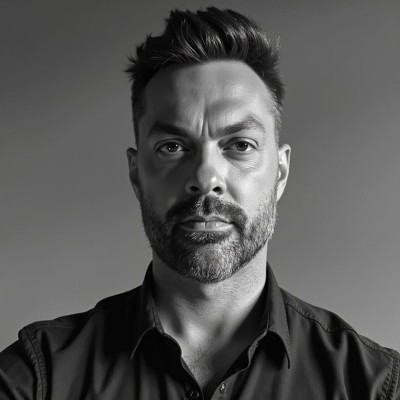
I was raised in an ashram.
Morning sadhana at 4am. Langar in the afternoon. Sacred music in every room of my childhood. I didn’t learn this world from the outside — it’s the only world I’ve ever lived in. My father, GuruGanesha Singh, founded Spirit Voyage Records and spent his life helping sacred chant find its audience. I spent ten years on the road managing Snatam Kaur: a decade of venues and load-ins and ticket counts, and that quiet moment before she walks on stage, when a room full of strangers becomes a congregation.
I’ve spent my whole life inside the world of yoga, meditation, sacred music and conscious events — I’m nearly fifty now — and the longer I was in it, the more I noticed something that bothered me.
The movement was everywhere. Yoga teachers, meditation teachers, kirtan artists, retreat leaders, breathwork facilitators, festival organizers, venues, retreat centers, musicians, whole spiritual communities. Thousands of people creating spaces where others could practice, learn, heal, connect and grow. They were already connected by relationships.
But the infrastructure treated them as if they weren’t.
The Ecosystem Was Always There
Most event platforms are very good at what they were built to do: create an event, sell a ticket, get someone through the door. But that’s not really how this world works.
Someone discovers a yoga teacher. They come to a class, then a workshop, then a retreat six months later. They discover a meditation teacher through that retreat. They hear a musician at a gathering and follow them to another city. They bring a friend. The relationship doesn’t end when the event does.
It keeps moving.
That’s what I kept seeing, over and over: the event was just one moment in a much larger relationship. But the technology underneath it was fragmented. Ticketing lived in one place, email somewhere else, marketing somewhere else again. An artist had one audience. A teacher had another. A venue had its own database, a retreat center its own website.
The ecosystem was there. We just didn’t have infrastructure that recognized it as an ecosystem.
So Everyone Did It Themselves
I watched extraordinary teachers — people who could hold a room of two hundred in complete stillness — go home and write their own marketing emails at 11pm. Guess at ad copy. Try to figure out Facebook. Wonder why their retreat wasn’t filling. Pay for advertising they couldn’t really measure. Build another website. And every time they created something new, they often had to start the work of finding their audience all over again.
None of that is why they were called.
That’s the part that kept me up. Not the fees.
The waste.
These are people who were called to teach, create, gather, heal, perform and serve. Yet many of them were spending their scarcest hours becoming part-time marketers, ticketing administrators and technology managers.
And it wasn’t just the individual teacher who lost something. The movement did too. When every yoga teacher has an isolated audience, every artist an isolated website, every venue its own calendar and every event its own platform, the connections between them become invisible. A yoga student might never discover the retreat happening two towns away. Someone who loves one kirtan artist might never hear about another. A retreat center might have the perfect teacher for its community without ever finding them.
The problem wasn’t that the consciousness movement was disconnected. The problem was that our infrastructure didn’t reflect how connected it already was.
I Kept Waiting for Someone to Build It
For a long time, I assumed someone would eventually build the alternative — a platform that understood these weren’t isolated transactions, a place where the relationships between teachers, artists, organizers, venues and seekers could become an asset to the entire community.
Eventually, I realized I was waiting for someone who wasn’t coming.
So we built BrightStar.
Not simply another ticketing platform. Not another generic event marketplace. We built it around a simple idea: what if the infrastructure reflected the way this movement actually works?
What if an artist could be discovered through an event? What if a teacher’s audience could help another teacher find theirs? What if someone attending a meditation workshop could naturally discover the retreat, festival or kirtan gathering that might be their next step — instead of all of it disappearing into separate platforms?
One Movement. Many Paths.
I came into this world through one particular doorway: ashram life, Sikh tradition, sacred music, bhakti, and the artists and teachers I worked with for decades. But that was only one stream.
Over the decades, I watched the larger movement unfold. Yoga. Meditation. Buddhism. Sufism. Christian contemplative practice. Indigenous and earth-based traditions. Breathwork, sound healing, conscious dance, somatic work. Retreats and festivals. Wisdom teachers, and independent practitioners quietly building communities of their own.
Different traditions, different languages, different practices, different doorways — but an enormous amount of shared ground.
I don’t think those traditions need to become the same. Their diversity is one of the great strengths of this movement. The opportunity is to create a structure that lets all of these streams remain themselves while still benefiting from being part of something larger.
That’s what we’re building. Not a new spiritual movement. Not a belief system. Not a replacement for the communities that already exist. Infrastructure for the communities that already exist.
What That Looks Like in Practice
This isn’t a pie-in-the-sky idea about everyone holding hands. It has to work in the real world. A yoga teacher needs to fill a workshop. A musician needs to sell tickets. A retreat organizer needs to reach the right people. A venue needs to find great programming. An event creator needs to build an audience without spending every night learning digital marketing.
So here is one concrete shape it takes. A teacher puts a retreat on sale and invites the musician playing it to share their audience — for that one event. The musician approves it from a link. Their people see the retreat. The teacher sees how many were reached, and never sees a single contact: the list stays in the musician’s hands, authorized for that event alone. When the room fills, the musician is paid for the reach they brought.
Two audiences that were always adjacent finally act like it, without either person giving anything away.
That’s why BrightStar brings ticketing, event discovery and marketing together, and why we’re building a network of artists, teachers, organizers and venues rather than treating each event as an isolated transaction. It’s why discovery matters as much as ticketing, why your audience should remain yours, and why your brand should remain yours. And it’s why the marketing side isn’t just another set of tools to learn — we’re building systems that take much of the work of promoting an event off the creator’s plate entirely.
The technology is practical. The idea behind it is bigger. We’re trying to build the connective infrastructure for a movement that is already here.
The Door Is Already Open
There is something else I should say plainly, because it is easy to miss: the platform itself is free. Not free-trial free. Not free-until-you-grow free. Free.
Post your profile as a teacher, an artist, a healer, a guide. List your venue, your studio, your retreat center. Put your gatherings on the calendar — every one of them, whether you sell tickets through us or somewhere else entirely. There is no requirement to use our ticketing to belong here. The directory is not a funnel dressed up as a community; it is the commons this movement never had.
Because that is what BrightStar actually is, underneath everything: a living directory of the global conscious movement. The kirtan artists and the sound healers, the yoga studios and the meditation centers, the retreat lands and the festivals — findable in one place, connected the way they have always really been connected.
So this is the invitation: add yourself. List your space. Put your next gathering on the map. It takes a few minutes and costs nothing — and every profile added makes the whole ecosystem easier to find, for everyone in it.
We Hold the Infrastructure. You Hold the Light.
I don’t think the world needs another company telling yoga teachers how to teach, artists how to create, or spiritual communities what to believe. You already know how to do your work. What you shouldn’t have to do is spend your nights wrestling with technology just to make that work possible.
So we’ll hold the infrastructure — the ticketing, the discovery, the marketing, the connections, the systems that help one event lead naturally to the next. You hold the teaching, the music, the practice, the gathering, the community.
You hold the light.
I’m not writing this to sell you something today. I’m writing because you’re one of the people who holds this movement up. Maybe you’re a yoga teacher with twelve students. Maybe you’re an artist traveling from city to city. Maybe you create a space where people can sit quietly and remember something important about themselves.
Wherever you are in this ecosystem, you’re already part of it. BrightStar exists to help connect the threads, because the ecosystem already exists. We just built the infrastructure to help it work as one.
We hold the infrastructure. You hold the light.
— Akal Sahai Khalsa
Founder, BrightStar