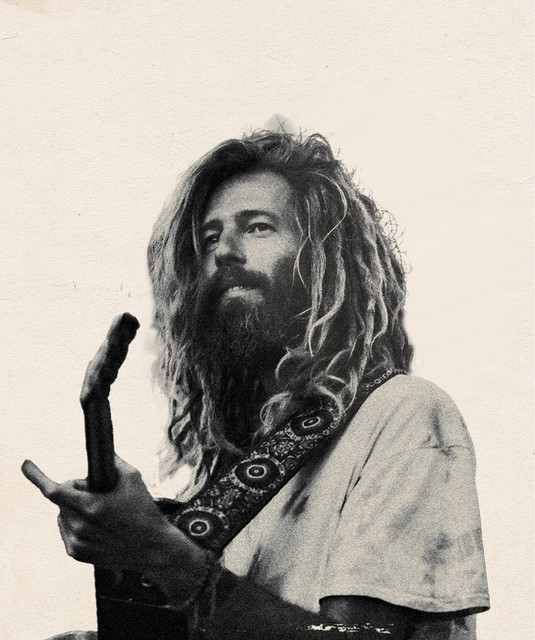
Sam Garrett's live performance of "I & I" is a kirtan rooted in Rastafari philosophy, dedicated to his elder teacher Ras Bongo. The song explores the fundamental spiritual principle that separation between beings is illusory—that while outer appearance and circumstance may differ ("only the shade"), the heart recognizes no difference between self and other. The piece combines collective call-and-response with harmonic layering to embody the teaching that all arise from the same source and must recognize their essential unity to create a world of love, truth, and freedom.
What does "I & I" mean in Rastafari philosophy?
In Rastafari tradition, "I & I" is more than grammatical—it is a statement of non-duality and the primacy of consciousness. Rather than separating the speaker ("I") from the listener ("you"), the phrase insists on a single unified awareness. Sam Garrett's teacher Ras Bongo articulated this directly: "There is no difference between I&I, only the shade, but look there (points to his heart) no difference there." The teaching acknowledges that humans appear different in form, color, circumstance, and cultural expression—these are the "shades." Yet these differences are superficial. When attention moves to the heart, the location of true knowledge and being, all distinction dissolves. All consciousness, all life, flows from the same source. This is not sentiment but a diagnostic statement about the nature of reality, one that carries ethical and spiritual implications for how we relate to one another.
How does the song structure the journey from separation to unity?
The performance opens with a communal grounding ("hey family how you feeling are you alive yeah you so good") that establishes shared presence before introducing the core teaching (at 30s): "we give thanks for life and praises to the most high." This immediate turn toward gratitude and acknowledgment of a transcendent source frames everything that follows. The lyrics then pose the central problem and solution: "what is your time imprisoned in the mind or if you seek you shall find what we're looking for is right inside." The mind creates the prison of time, separation, and doership. The solution is not intellectual but phenomenological—seeking inward reveals that "what we're looking for is right inside." This inward seeking is not introspective self-examination but recognition of the eternal presence already at the heart.
The refrain "so don't bargain don't make my children we're bringing love to each and every nation we do good know we are evil we have to come together as one people rise up into the light" (at 57-72s) moves from the interior realization to collective action. The teaching is not about individual enlightenment alone but about communities and nations learning to see their essential oneness. This is why love must be brought "to each and every nation"—not as charity but as recognition of kinship. The rising phrase "rise up into the light" signals the shift from darkness (separation consciousness) to illumination (unity consciousness).
What role does repetition play in embodying the teaching?
Beginning at 77-94s, the central mantra emerges: "I am I am I am I am I am I am." The repetition is not hypnotic or trance-inducing in a negative sense; rather, it allows the mind to release its habitual narrative and settle into the bedrock of being. Each iteration peels away a layer of identity constructed by thought, memory, and social conditioning, revealing the simple undeniable fact: I am. This is Sat-Chit-Ananda (being-consciousness-bliss) expressed in a single phrase. The backing vocals and harmonium create a living container around this declaration, so that even as the individual singer repeats "I am," the whole band holds and amplifies it. This sonically demonstrates the teaching: the individual voice is never isolated; it always arises within and is held by a larger whole.
How does the bridge address the problem of duality directly?
At 168-199s, the song takes a deliberate turn: "oh Father guide us on this journey called oh Father guide us through the lows and the highs father guide us or let us bath in your life oh the guidance oh help us all realize there's no me and you is only I and I." This passage moves from celebration and teaching to a direct prayer for the recognition of unity. The "lows and the highs" acknowledge that the human journey includes struggle, loss, and limitation—not conditions to bypass but to witness with faith. Then comes the climactic statement: "there's no me and you is only I and I." This is not poetic metaphor. It is the assertion that the fundamental duality that structures experience (self and other, subject and object) is revealed, upon direct seeing, to be false. There is only I and I—one consciousness appearing in the form of apparent multiplicity.
The phrase "let us bath in your life" suggests that this realization is not achieved through effort but through surrendering into the life that is already living us. We do not attain unity; we stop believing in separation and allow ourselves to be bathed in the undivided life.
What is the historical and personal context for this song?
According to the description, "I & I" was inspired by Sam Garrett's Rastafari elder and teacher Ras Bongo, whom he met during time in Jamaica. Ras Bongo embodied the teaching—he was, in Garrett's words, "the embodiment of Joy, Love and Kindheartedness." Importantly, Ras Bongo died while Garrett was on tour in Germany, yet rather than being a moment of closure, this catalyzed the creation of a song that "carries his spirit." This is a significant detail: the song is not a memorial to a person who is gone but a vehicle for a presence that continues. Because Ras Bongo taught that there is "no difference between I&I," his passing is not a final separation. The song becomes a way of keeping the teaching and the elder alive in circulation, continuing to transmit his presence and wisdom. Garrett explicitly states: "Truly this elder and his family have changed my life forever and I am grateful and blessed to be able to continue sharing their message in the world today."
This suggests a living tradition of knowledge transmission. The teaching is not hoarded or intellectualized but sung, performed, and shared across venues and nations. The upcoming live album (released February 24, 2025) and the extensive tour dates listed (spanning New Zealand, Australia, Indonesia, Norway, Italy, Canada, Germany, and Poland) indicate that the song is part of a deliberate effort to spread the message of unity and love globally.
What does the closing invitation mean?
The final movement (around 236-305s) strips the song down to its most essential prayer: "yeah you come and guide me home come my way come my way come my way come my way." Home, in this context, is not a geographic location but the return to unity consciousness, the dissolution of the illusion of separation. "Come my way" is simultaneously an invitation to divine grace and an assertion that this grace is not distant but intimately aligned with one's own deepest inclination. The repeated "I am" that follows ("yes I I'm singing I am I") returns the individual voice to the substrate of being from which all appearance arises.
The closing gratitude—"give it up for my amazing band"—is not separate from the teaching. Garrett acknowledges that the realization of I and I cannot be performed alone; it requires the collective. The band, each musician contributing their part, embodies the teaching in real time. The drummer, bassist, keyboardist, harmonium player, and backing vocalists are not subordinate to a single star but participants in a unified expression. This sonic community becomes a living model of the non-duality being sung about.
Where to go from here
For those interested in exploring the lived reality of this teaching, the practice of kirtan—responsive chanting and singing in a group—is a direct method. Unlike lecture, which primarily engages the intellect, kirtan engages the heart, breath, and nervous system. Regular practice with "I am" or "I and I" affirmations, especially in group settings, can gradually dissolve the psychological boundary between self and other. Reading primary Rastafari texts or listening to elder teachers can deepen intellectual understanding of the philosophy. Visiting places of spiritual community and practice—whether reggae circles, kirtan gatherings, or meditation groups—allows the teaching to be witnessed in embodied form. Finally, reflecting on the phrase "look there (points to the heart) no difference there" in quiet moments can catalyze direct insight. The teaching is not meant to remain in the song; it is an invitation to see what is actually true about your own nature and the nature of those around you.