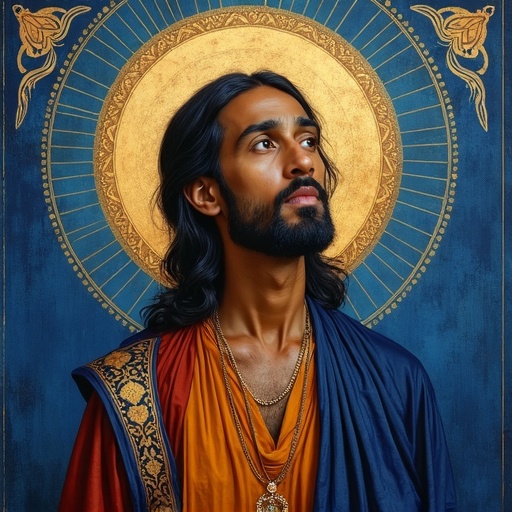
"Guru Brahma" is an ancient Sanskrit prayer that forms the opening track of both Jai Uttal's original Shiva Station album and its re-envisioned acoustic version, Return to Shiva Station. The prayer invokes and bows to the guru's presence as the supreme teacher whose form pervades every molecule of both animate and inanimate creation, offering foundational teachings on what the guru truly represents across multiple layers of spiritual practice—from meditation to liberation itself.
What Is "Guru Brahma" and Why Does It Matter?
"Guru Brahma" is not a modern composition but an ancient Sanskrit invocation—a prayer of deep reverence directed toward the guru. In the context of Jai Uttal's acoustic performance, this prayer serves as the gateway into his spiritual music exploration. The song sets the tone for understanding the guru not as a mere human teacher, but as a cosmic principle that operates at every level of existence and spiritual practice.
The prayer carries multiple layers of meaning, each verse addressing a different aspect of who and what the guru truly is. By beginning with this ancient invocation, Uttal frames the entire Shiva Station project—which is about "the power and mystery of Shiva, the dancing Lord of Transformation and Protector of Devotees"—as fundamentally rooted in the guru principle itself. The guru, in this view, is inseparable from the ultimate spiritual reality.
The Four Verses and Their Meanings
The prayer consists of four distinct Sanskrit verses, each revealing a different dimension of the guru's nature and function:
The Guru as All-Pervading Presence
The first verse reads: Akhanda Mandala Akaaram, Vyaaptam Yena Cara Acaram Tat Padam Darshitam Yena, Tasmai Shrii Gurave Namah. This translates to: "Salutations to the Guru whose form is everything, and who pervades the entire animate and inanimate creation, who—out of Grace—gives us the Darshan of His Lotus Feet."
This opening invocation establishes the core teaching: the guru's form is not limited to a physical body or personality. Rather, the guru's presence extends throughout all of creation—both the moving (animate) and the non-moving (inanimate). Mountains, oceans, plants, animals, and humans all reflect the guru's pervading presence. This understanding transforms how one relates to the world; each moment of perception becomes an opportunity to recognize the guru's teaching presence woven throughout existence.
The Guru as Remover of Ignorance
The second verse—Ajnyaana Timirandhasya, Jnyaananjana Shaalaakayaa Cakssuunmilitam Yena, Tasmai Shrii Gurave Namah—addresses the guru's transformative function: "Salutations to the Guru who removes the darkness of ignorance from our blind eyes by applying the collyrium of knowledge. By whom our inner eyes are opened; salutations to that Guru."
Here the guru is described as a physician of ignorance. Using the metaphor of applying medicinal collyrium (a healing substance for the eyes), the prayer acknowledges that human beings are born in spiritual blindness—unable to see the truth of their own nature or the nature of reality. The guru's function is to apply the medicine of knowledge, opening the inner eye of wisdom. This is not intellectual knowledge alone but direct recognition and vision.
The Guru as the Creator, Preserver, and Destroyer
The third verse—Gurur Brahmaa, GururVishnu, Gururdevo Maheshvarah Guru Sakshat Param Brahma, Tasmai Shrii Gurave Namah—is the verse that gives the song its name: "The Guru is Brahma, the creator. The Guru is Vishnu, the preserver. The Guru Deva is Maheswara Shiva, the destroyer. The Guru is truly the Para-Brahman (Supreme God); salutations to that Guru."
This verse draws on Hindu cosmology's trinity (trimurti). Brahma represents creation, Vishnu represents preservation, and Maheshvara (Shiva) represents destruction and transformation. By identifying the guru with all three, the prayer suggests that the guru embodies the entire cosmic process. The guru is not separate from the ultimate ground of being (Para-Brahman) but is its living expression. This teaching elevates the guru from a role model or instructor to a direct manifestation of the divine principle itself.
The Guru as the Root of All Spiritual Practice
The final verse—Dhyaana Muulam Gurur Muurtih Puujaa Muulam Gurur Padam Mantra Muulam Gurur Vaakyam Moksha Muulam Guruur Krpaa—states: "The Root of Meditation is the Form of the Guru. The Root of Worship is the Feet of the Guru. The Root of Mantra is the Word of the Guru. The Root of Liberation is the Grace of the Guru."
This verse crystallizes the practical significance of the guru across the major pillars of spiritual practice. In meditation, the guru's form becomes the focal point—not as an act of idolatry but as a way to access the guru's presence within one's own consciousness. In worship, the guru's feet (a symbolic gesture of surrender and reverence) represent the totality of what deserves veneration. In mantra practice, the guru's word—the teachings and the sacred syllables transmitted by the teacher—provides the foundation. And most fundamentally, liberation itself is understood as the result of the guru's grace, not merely human effort.
The Spiritual Significance of the Prayer Format
By presenting "Guru Brahma" as a sung prayer rather than as doctrine, Jai Uttal activates the devotional dimension of these teachings. The Sanskrit words themselves are believed to carry vibrational and energetic qualities. When chanted or sung, they are meant to invoke the actual presence they name. This is why the prayer opens with invocational phrases like "tasmai shrii gurave namah"—literally "salutations to that guru"—repeated as a form of direct address and offering.
The acoustic arrangement on Return to Shiva Station heightens this intimate quality. Stripped of production layering, the listener encounters the raw power of the prayer-song. As Jai describes the album, these "unadorned, intimate arrangements illuminate directly the spiritual heart of each composition." The simplicity allows the listener's own inner ear to activate; there is less sonic decoration and more space for the prayer to work directly on consciousness.
How "Guru Brahma" Frames the Shiva Station Project
The placement of "Guru Brahma" as the opening track of both versions of Shiva Station is deliberate. By beginning with an invocation to the guru, Jai establishes the context for everything that follows. Shiva Station, as Jai has explained, explores the power and mystery of Shiva and his connection to Mount Kailash in Tibet. Yet Shiva himself, in the Hindu tradition, is understood as the supreme guru—the one who teaches through silence, through cosmic dance, through the very process of dissolution and renewal.
By opening with "Guru Brahma," the album acknowledges that to encounter Shiva's teachings authentically, one must first attune to the guru principle—the capacity to receive, to be taught, to have one's ignorance dispelled. This establishes a receptive posture in the listener before moving deeper into the exploration of Shiva's nature and teachings.
Where to Go from Here
To deepen engagement with "Guru Brahma," consider exploring the full Return to Shiva Station album to understand how this opening prayer informs the entire collection. The studio album uses intimate, acoustic arrangements that allow the spiritual content to shine without production artifice. Additionally, studying the Sanskrit directly—learning the proper pronunciation and understanding the etymological roots of words like "darshan" (direct vision), "mantra" (transformative sound), and "guru" itself—enriches the prayer's impact. Finally, reflecting on your own relationship to the guru principle—both as an external teacher and as an inner guide—allows the prayer's teachings to become a lived practice rather than merely intellectual knowledge.