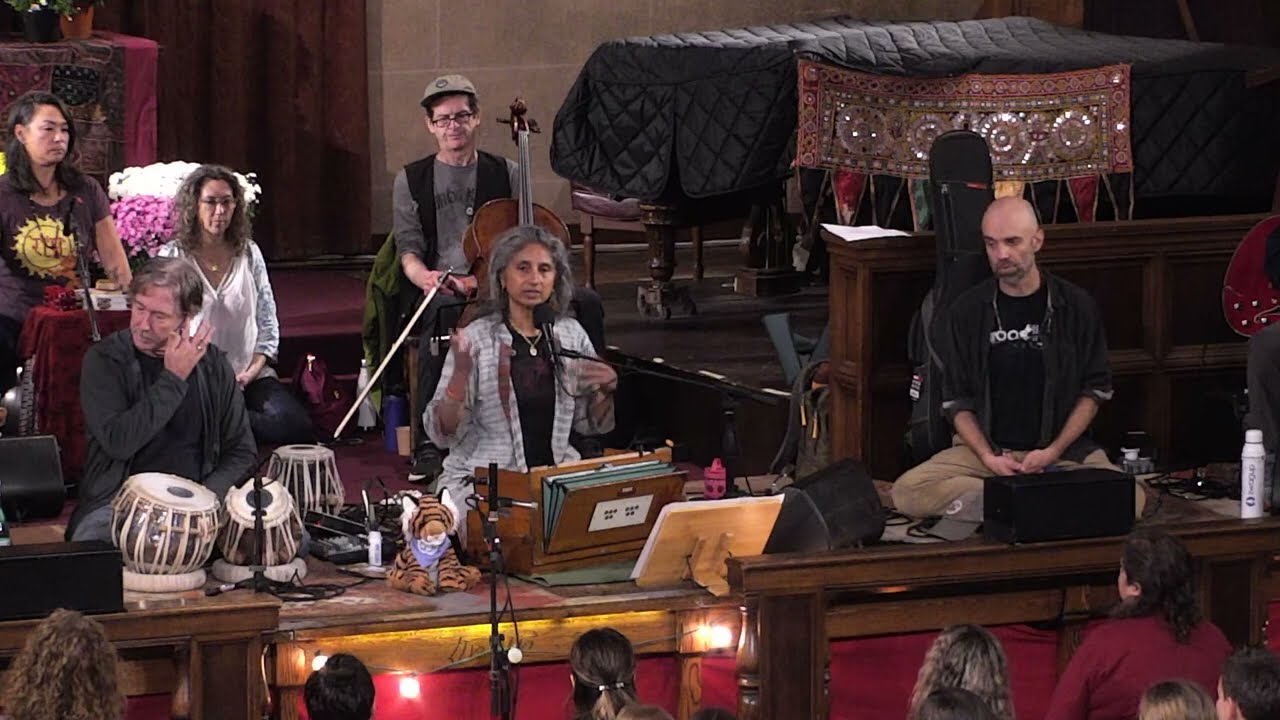
"Be The Change" is a kirtan-style devotional song that invokes the names and wisdom traditions of multiple spiritual teachers—Krishna, Jesus, Buddha, and Gandhi—to articulate a unified vision of consciousness. The song moves beyond sectarian boundaries to posit that diverse spiritual paths share a common ground: the recognition of "one love, one blood, one life" that connects all beings as sisters and brothers. At its core, the piece argues that awakening to this shared consciousness and the principle that "peace is the only way" is the prerequisite for seeing the change we wish to manifest in the world.
Why Do Spiritual Traditions Keep Returning to Similar Truths?
One of the central insights of "Be The Change" is that spiritual seeking appears across cultures and eras through radically different figures. The song names Krishna, Jesus, Buddha, and Gandhi—each from distinct traditions and historical moments—yet treats them not as competing authorities but as waypoints toward the same underlying realization. The opening verses state: "everybody's talking about Krishna," "everybody's talking about Jesus," "everybody's talking about Gandhi," establishing that people across the world are drawn to these figures and their teachings.
This naming strategy sidesteps doctrinal debates about which tradition is "correct" and instead asks: What if the repetition of similar themes across traditions points to something universal? The song suggests that when individuals speak of Krishna consciousness, Christian love, Buddhist enlightenment, or Gandhian nonviolence, they are all reaching toward the same existential truth. Rather than fragmenting spirituality into separate boxes, the song treats diverse teachers as transmitters of a single message adapted to their times and cultures.
The refrain—"one love, one blood, one light in everyone, one life, give to each other, we are sisters and brothers"—crystallizes this insight. It moves away from abstract theology and grounds spirituality in kinship. The acknowledgment that we "give to each other" and recognize ourselves as "sisters and brothers" is not metaphorical sentimentality; it reflects a direct perception that individual separateness is illusory and that all consciousness shares a common source.
What Does "Everybody's Talking About Consciousness" Really Mean?
Later in the song, the focus shifts from naming specific teachers to naming a quality: "everybody's talking about consciousness, everybody wants that eternal kiss." This move is significant. Rather than treating Krishna or Jesus as distant historical figures, the song brings the inquiry into the present moment—what are people actually seeking now?
The phrase "everybody wants that eternal kiss" is poetic shorthand for the direct experience of unity with the divine or ultimate reality. An "eternal kiss" suggests intimacy, reunion, the dissolution of the barrier between self and other, between the seeker and what is sought. In many contemplative traditions, this reunion is the goal: in Advaita Vedanta, it is the recognition of Brahman; in Christian mysticism, it is union with Christ; in Sufism, it is fana, the annihilation of the separate self in divine presence.
The song observes that "everyone saying there's more than this," acknowledging a widespread intuition that ordinary waking consciousness does not exhaust reality, that there are deeper dimensions available to human experience. This is not claimed as dogma but as a shared recognition across spiritual seekers. The song also notes that "everyone wants to follow their own place"—suggesting that while the destination may be universal, the path is personal. One does not need to adopt Krishna worship if one's natural inclination is toward Christianity or Buddhism; what matters is sincere engagement with one's chosen practice.
How Does the Song Frame the Relationship Between Inner Awakening and Outer Change?
The bridge of the song marks a crucial turning point: "It's time we wake up, do a bring-a-day, realize peace is the only way." The imperative "wake up" invokes the language of enlightenment traditions—the notion that ordinary consciousness is a kind of sleep, a dreamlike state from which one must awaken. But what does waking up entail?
The song is clear: recognizing that "peace is the only way." This is not a plea for passive nonviolence, though it aligns with Gandhi's teaching of ahimsa. Rather, it posits that peace—as an inner state and an outer reality—is the foundation upon which all sustainable change must be built. Conflict, violence, and coercion may produce temporary shifts in power, but they do not resolve the underlying illusion of separation. A change built on force will replicate the consciousness that created the problem in the first place.
What follows is the verse: "We're walking out of yesterday, we can rise up together, see the change we want to see in the world today." The phrase "walking out of yesterday" suggests a clean break from old patterns of consciousness—tribalism, sectarianism, the assumption that one group's gain must be another's loss. "Rise up together" emphasizes that the change is collective, not the achievement of an enlightened few imposing their will on others. And crucially: "see the change we want to see in the world." This echoes Gandhi's famous maxim, "be the change you wish to see in the world." The song frames this not as individual heroism but as a unified uprising grounded in the recognition of shared consciousness.
What Is the Role of Mantra and Repetition in This Message?
A significant portion of the song consists of the repetition of "Shanti, Shanti, Shanti"—Sanskrit for "peace." Kirtan, the devotional singing tradition from which this song draws its form, relies heavily on call-and-response and repetitive chanting. This is not merely aesthetic; the repetition serves a function. In many spiritual traditions, the repeated utterance of a sacred sound or name is believed to attune the nervous system and consciousness to the vibration it represents.
By chanting "Shanti" over and over, the song does not just talk about peace as an intellectual concept; it invites the listener to embody and vocalize peace. The body, the breath, and the voice become instruments of the teaching. This aligns with the kirtan tradition's understanding that spiritual work is not purely mental but involves the whole being—heart, body, voice, and presence.
The repetition also has a democratic quality. Kirtan is often performed in groups, with a lead singer and a chorus of participants. Everyone is invited to sing, regardless of spiritual attainment or education. This stands in stark contrast to traditions where spiritual authority is concentrated in a priesthood. By making the teaching participatory and embodied, the song suggests that awakening and the cultivation of peace are not elite pursuits but available to anyone willing to sing, listen, and reflect.
Is the Song Suggesting That All Religions Are the Same?
A careful reading reveals that "Be The Change" is not arguing that all religions are identical. It does not flatten important differences in doctrine, practice, and historical context. Rather, it suggests a principle of religious pluralism: that multiple traditions can be authentic pathways to awakening, and that at their deepest level, they converge on certain shared insights about consciousness, unity, and the ethical imperative to reduce suffering.
This is a middle way between two extremes: exclusivism (only my tradition is true) and relativism (all truths are equal and interchangeable). The song holds that spiritual traditions are diverse yet interconnected, like rivers flowing from different peaks but toward a common ocean. A person can be deeply committed to one tradition while honoring the validity of others.
The emphasis on "one love, one blood, one light in everyone" suggests that beneath doctrinal differences lies a shared recognition: the fundamental interconnectedness and equality of all beings. This principle appears in various forms across traditions—as the Hindu concept of Atman (the self in all), the Christian affirmation that all are created in God's image, the Buddhist teaching of Buddha-nature inherent in all beings, and the Islamic concept of the divine unity (tawhid) that encompasses all existence.
What Does "Be The Change" Demand of the Listener?
The song is not merely inspirational; it makes specific demands. It calls the listener to wake up—to interrupt habitual patterns of thought and perception. It asks them to realize peace as not an abstract ideal but as the foundation of all meaningful change. It invites them to rise up "together"—to recognize that transformation cannot be a solitary achievement but must be collective and grounded in the recognition of shared consciousness.
The song does not promise that awakening will be comfortable or easy. The phrase "walking out of yesterday" suggests leaving behind familiar patterns, identities, and worldviews. It demands a reorientation of consciousness—a shift from perceiving others as competitors, threats, or fundamentally different to seeing them as sisters and brothers, as expressions of the same consciousness.
Finally, the song asks the listener to embody the change now, in this day, in this moment. "See the change we want to see in the world today"—not tomorrow, not after some future enlightenment, but today. This is consistent with many contemplative traditions' insistence that spiritual awakening is not deferred to the afterlife or a distant future but is available in the present moment, here and now.
Where to go from here
If "Be The Change" resonates with you, consider exploring the specific traditions it invokes: read the Bhagavad Gita or Upanishads for Hindu perspectives on consciousness and duty; study the Gospels or Christian mystics like Meister Eckhart for Christian approaches to divine unity; investigate the Buddha's Four Noble Truths and teachings on interdependence; and read Gandhi's writings on nonviolence and his vision of swaraj (self-rule rooted in inner transformation). You might also explore the kirtan tradition itself through practitioners like Krishna Das, Radhanath Swami, or other contemporary devotional singers who work in this genre. Finally, if the song's call to collective awakening speaks to you, consider how you might "be the change" in your own sphere—whether through practices like meditation and service, by cultivating peace within yourself, or by engaging in communities committed to justice and interconnectedness.