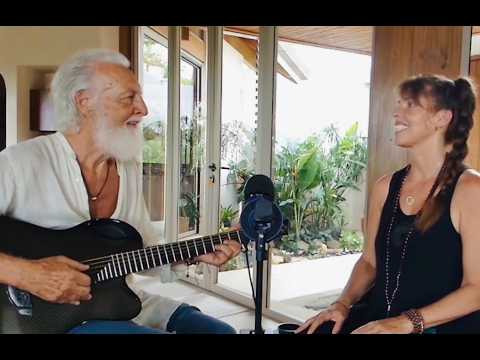
This live performance captures Deva Premal and Miten rendering the Seven Chakra Gayatri Mantra, a contemporary devotional composition that maps the ancient Gayatri invocation across the body's seven chakras. Composed by Deva Premal and Joby Baker, the piece fuses classical mantra structure with a framework designed to awaken and harmonize each energy center—from root to crown—through sustained melodic and sonic alignment. The performance opens with the Jagadamba Shloka, establishing the sacred container before the central mantra unfolds as a journey through the subtle anatomy.
What is the Gayatri Mantra and why map it to the chakras?
The Gayatri Mantra is one of the oldest and most revered invocations in Hinduism and yoga, traditionally a meditation on the sun god Surya and the illuminating power of consciousness. The classic Sanskrit text—Aum Bhur Bhuvah Svah / Tat Savitur Varenyam / Bhargo Devasya Dhimahi / Dhiyo Yo Nah Prachodayat—calls for the activation of divine intelligence and the illumination of the mind. For centuries, practitioners have chanted it as a tool for purification, mental clarity, and spiritual awakening.
Mapping this mantra to the seven chakras is a modern interpretive choice that honors both the mantra's original potency and the chakra system's framework for understanding subtle energy. Rather than treating the chakras as purely metaphorical, the Seven Chakra Gayatri Mantra design suggests that sacred sound can be directed intentionally through specific energy centers, activating different qualities of consciousness at each level:
- Root Chakra (Muladhara): Grounding, stability, survival consciousness
- Sacral Chakra (Svadhisthana): Creative flow, sexuality, emotional expression
- Solar Plexus Chakra (Manipura): Personal will, transformation, digestive fire
- Heart Chakra (Anahata): Compassion, connection, the seat of the soul
- Throat Chakra (Vishuddha): Expression, truth, vibration and sound
- Third Eye Chakra (Ajna): Intuition, insight, inner vision
- Crown Chakra (Sahasrara): Unity consciousness, dissolution of separation
How does Deva Premal compose for mantra practice?
Deva Premal, a Grammy-nominated mantra artist and composer, approaches mantra music with careful attention to melody, harmonic resonance, and accessibility without diluting the sacred intent. Her compositions—including this Seven Chakra Gayatri, co-created with producer Joby Baker—blend traditional Sanskrit phonetics with contemporary production and musical arrangement. The goal is not to reinvent the mantra but to create a sonic container that supports deep practice and allows the mantra to land in the body and nervous system of modern practitioners.
In this arrangement, the melody is designed to carry the listener through the chakra sequence while maintaining the Gayatri's original vibrational signature. Miten, Deva Premal's longtime collaborator and vocalist, provides the voice that anchors the performance. His approach emphasizes clarity, devotion, and a quality of presence that invites the listener into the practice rather than performing it at them. This distinction—between performing a mantra and offering it as a spiritual practice—is central to how Deva Premal and Miten approach live presentation.
Why does the performance open with the Jagadamba Shloka?
The opening invocation in this live recording is the Jagadamba Shloka, composed by Nicola Janet Wells. A shloka is a verse of praise, and Jagadamba refers to the Divine Mother in her transcendent form. By opening with this invocation, the performance establishes what might be called the sacred container—a space consecrated by calling upon the presence and blessing of the Divine Mother before the main practice unfolds.
This is a common structure in traditional Indian spirituality: begin by acknowledging and invoking the presence of the divine, thereby aligning the consciousness of both practitioners and listeners with that higher power. The Jagadamba Shloka thus serves both a practical and energetic function—it prepares the mind for receptivity and shifts the space from ordinary time into sacred time. Once that invocation is complete, the Seven Chakra Gayatri Mantra has a prepared ground in which to take root.
What role does live performance play in mantra transmission?
Recorded mantra performances exist in a unique category. They differ from studio-produced albums because the energy of a live audience, the presence of other practitioners, and the spontaneity of real-time singing create an atmosphere distinct from the controlled environment of a recording studio. When hundreds or thousands of people gather in a concert hall or festival to sing or listen to mantra together, a collective energetic field is generated. This is sometimes described as satsang—the company or association of truth—where the presence of sincere seekers amplifies the power of the practice.
From the perspective of mantra practice, a live recording captures this collective resonance. Those who listen later are connecting, across time, with the actual vibration and intention that was present in the room. This is why devotional practitioners often value recordings of live kirtan or mantra performances by accomplished singers: they believe the recording retains some measure of the energetic transmission that occurred during the original event.
How do chakra-mapped practices integrate with breath and awareness?
While this particular recording is presented as a listening experience, practitioners often use chakra-mapped mantra sequences as a guided meditation or breath-synchronized practice. The idea is to mentally follow the path of the mantra through the body as it is sung, using visualization, breath, and sound awareness to activate each center in turn. Some practitioners imagine the mantra traveling upward through the spine with each verse or section. Others focus their breath or attention on each chakra as the corresponding portion of the mantra unfolds.
This multi-sensory integration—hearing the mantra, feeling it in the body, directing breath and attention consciously—is what transforms a mere recitation into a yoga practice. The chakra framework provides a roadmap for where awareness is meant to travel, making the subtle body less abstract and more tangible as a field of conscious engagement.
What is the role of melody in mantra medicine?
In traditional Vedic chanting, the melody is not decorative—it is essential to the mantra's power. Each note, interval, and tonal quality is believed to carry specific frequencies that affect the nervous system, glands, and subtle energy pathways. When Deva Premal and Joby Baker composed the Seven Chakra Gayatri, they selected melodies that are both memorable and resonant with the chakra system's own harmonic logic.
For example, lower registers and slower tempos tend to activate grounding and stabilizing energy, which aligns with the root chakra work. As the mantra ascends through the chakras, the melody often rises in pitch, supporting the inner journey upward. The throat chakra, being the seat of vibrational expression and sound itself, may be emphasized through particular clarity or brightness in the vocal presentation. These choices are not arbitrary; they reflect an understanding of how sound medicine works in the body.
Where to go from here?
If this live recording resonates with you, several paths of deepening are available. First, listen repeatedly and allow the mantra to become familiar, so that your mind can rest in the sound rather than working to follow it. Second, experiment with singing or chanting along, letting your own voice join Miten's and become part of the transmission. Third, explore related practices by connecting with the Gayatri Sangha App or Deva Premal and Miten's wider discography, which includes other chakra-attuned and mantra-based compositions.
For those interested in understanding the chakra system more deeply, complementary study of tantric yoga philosophy or Kundalini practice will illuminate why mapping the Gayatri to the seven centers is not merely poetic but energetically significant. Finally, consider attending a live concert or retreat led by Deva Premal and Miten if the opportunity arises; the difference between a recording and being present in the collective field of such an event can be profound. The mantra is both a tool for solitary practice and a bridge to collective consciousness—both dimensions are valid and mutually enriching.