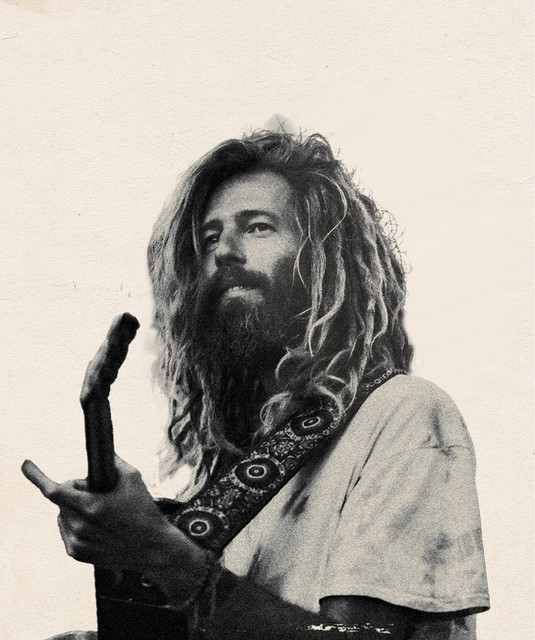
In this brief but potent performance filmed at Soul Revolution Festival, Sam Garrett leads a gratitude ceremony anchored in the affirmation "Love is our name." The practice moves beyond personal thanks to invoke ancestors—those who came before and those yet to come—and articulates a vision of a world built on equality, collective care, and familial love. The teaching uses call-and-response, rhythm, and embodied voice to transform gratitude from an individual sentiment into a collective commitment to justice and hope.
What does it mean to say "Love is our name"?
The opening refrain "Love is our name" functions as both identity statement and invocation. Rather than treating love as an emotion to be felt, Garrett presents it as the fundamental name—the essential identity—of the gathered community. This reframing makes love not contingent on feeling good or circumstance, but constitutive: it is who we are. By repeating this affirmation eight times in the opening moments (0:00–0:11), Garrett establishes a sonic and conceptual ground for everything that follows. The rhythm and repetition allow listeners to move the statement from intellectual understanding into the body, making the claim felt rather than merely understood.
This approach draws on call-and-response traditions often rooted in spiritual and Black musical practices, where repetition serves both as teaching method and as a way to knit individuals into collective consciousness. When others in the room echo "Love is our name," they are not just repeating words—they are affirming a shared identity and dissolving the boundary between performer and audience, between self and other.
Why give thanks to ancestors—past and future?
At 0:55, the ceremony shifts into its central teaching: "So we give thanks for life. Give thanks to all the ancestors that came before us and the ones still to come, to all the children still to come." This three-fold gratitude—honoring those before, those present, and those yet to be born—locates individual existence within a vertical continuum. It acknowledges lineage not as historical abstraction but as living, generative relationship.
By invoking "ancestors that came before," Garrett honors the sacrifices, wisdom, and resilience of prior generations. In many spiritual traditions, particularly those rooted in African diaspora practice, acknowledging ancestors is an act of recognition and reciprocity. It is a way of saying: we do not stand alone; we carry the strength of those who survived, resisted, and built what we inherit today.
Yet Garrett extends gratitude equally to "ones still to come" and "all the children still to come." This move is crucial. It reframes gratitude as not merely backward-looking but as a form of care projected into the future. To give thanks for children not yet born is to accept responsibility for the world we are creating for them. It is to subordinate present satisfaction to future flourishing.
What kind of world does this gratitude call into being?
From 0:65 onward, Garrett articulates the vision that gratitude activates: "May they be born into a world full of love and joy and hope. A world where everybody is taken care of. A world where we are all treated as equal, where we are all treated as family."
Notice the specificity here. This is not vague spiritualism. Garrett names concrete conditions: care, equality, and familial treatment. "A world where everybody is taken care of" gestures toward systems of mutual support and collective responsibility—an economy of sufficiency rather than scarcity or extraction. "Treated as equal" calls for the dismantling of hierarchies of power, status, and worth. "Treated as family" collapses the distance between stranger and kin, suggesting that the boundary of obligation and love should expand to include all beings.
These three conditions—care, equality, and familial bonds—are not separate. Rather, they form an integrated vision: a world structured on love that meets material needs, acknowledges the equal worth of all members, and binds them together in the responsibility and intimacy of family. This is a vision rooted not in sentimentality but in concrete justice and mutual obligation.
How does embodied voice serve this teaching?
The performance itself—the musicality, the call-and-response, the "Hey mama" refrain (0:27–0:44)—is not ornamental. Sam Garrett teaches through the body as much as through words. The repetition trains nervous systems into attunement. The call-and-response distributes agency; no one person does the teaching alone. The warmth of "Hey mama" creates tenderness and recognition. The breath and rhythm required to sing the affirmations moves listeners out of abstract thought and into felt experience.
This is consistent with many contemplative and healing traditions, where the vehicle of transmission is sound, breath, and synchronized movement rather than doctrine alone. The body learns what the intellect cannot fully grasp.
Where to go from here
If this teaching resonates, consider:
- Practice the affirmation: Begin your own day or gathering with "Love is our name," repeating it until you feel the claim in your body, not just your mind.
- Map your lineage: Spend time acknowledging those ancestors—blood and chosen—who made your current life possible. Where did they sacrifice? What did they teach?
- Envision future care: Meditate on the world you are helping to create for children yet unborn. What choices today align with that vision? What systems do you wish to build or transform?
- Practice collective gratitude: Gather with others and share thanks—not just for what you have received, but for what you hope to co-create. Let gratitude become a shared practice of commitment, not just appreciation.